
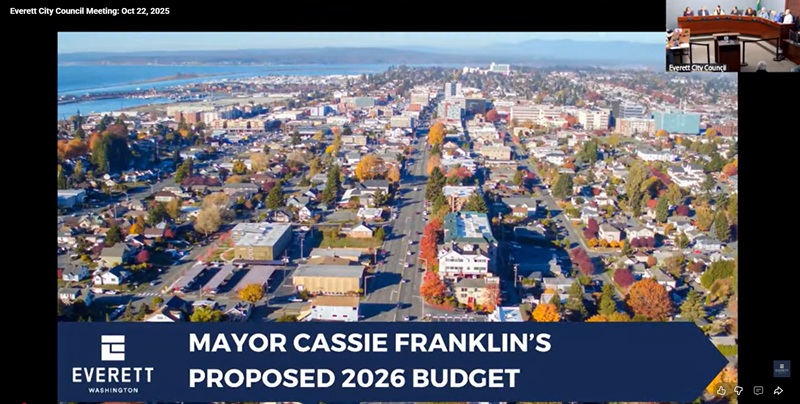
EVERETT, OCT. 24: Mayor Cassie Franklin presented her budget proposal, sharing a plan to address a $7.9 million deficit for 2026. The council also tabled a vote that would renew or neutralize the “no sit, no lie” ordinance.
Budget Address
For 2026, the city has to address a $7.9 million deficit within the general government fund. Last year, the city had to make a series of major cuts to services to address a projected $12.6 million deficit for 2025.
This year, the city does not anticipate any cuts to services or personnel to balance the budget. However, the city plans on reducing spending through a combination of one-time and long-term measures, such as freezing non-essential department spending and limiting city-provided grants.
Non-general government operations such as Everett Transit, city utilities and golf courses remain to be fully funded and self-sustaining, Franklin said. Funds in this sector can only be spent on specific services.
Alternatively, the general government fund relies on funding from taxes and fees. Since 2021 the city has had to face a structural budget deficit, closing nearly $100 million in deficits since 2018, Franklin said. The city has attributed the deficit to a 1% cap on annual property tax increases.
“Since 2020, inflation has increased, averaging roughly 5% per year. As our population continues to grow, so do the demands on city services. But, under the current cap, our primary revenue source can’t keep up,” Franklin said.
The total proposed budget amounts to $612.7 million across the general and non-general government. The city plans on reallocating COVID relief funds to help address shortfalls in the budget.
The Mayor’s priorities for 2026 remain the same, emphasizing public safety, quality of life, economic growth and serving vulnerable populations. Nearly 59% of the budget next year will be allocated to public safety, such as law enforcement.
The city will also suspend 2026 contributions to pre-funded pensions, which Franklin recommended re-evaluating the city’s policy of pre-funding pension funds.
“There are good reasons that other cities don’t do this, and we need to seriously consider if this practice should continue,” Franklin said.
To view the Mayor’s full budget address, see here.
‘No sit, no lie’ Vote Tabled for Later Date
The council voted to table a vote that would confirm or deny an extension of the “no sit, no lie” ordinance, which is scheduled to expire at the end of the year.
The law prohibits people from sitting or lying on blankets, sleepings bags, or similar equipment, in service or high-impact areas designated as buffer zones in downtown Everett.
The motion to table the vote came from councilmember Mary Fosse, who requested additional data from the administration on how the law impacts homeless individuals.
The “no sit, no lie” law was implemented in 2021 to improve community safety and address homeless encampments. The law additionally prohibits services and products from being given to individuals within buffer zones without a permit.
Within buffer zones, the city provides outreach, services and enforcement, according to the city website. A specific location also has to qualify for six or more qualifying events, which include 911 calls, neighbor complaints, or criminal behavior.
There have been 156 warnings given within buffer zones since the law went into effect, with 11 citations accompanied by a booking, Deputy Chief Robert Goetz said during the meeting.
A handful of residents spoke against the renewal of the law on Wednesday, citing concerns on affectedness and criminalizing homelessness.
“When people have nowhere else to sleep or rest, their choice to be outside is not voluntary. These laws disproportionately impact vulnerable populations, making the simple fact of being unhoused a punishable offense… and diverts resources and attention from the only interventions that have shown to actually be effective,” Everett resident Caitlyn McKinney said
While other public commenters approved the ordinance, claiming that it is a tool in addressing crime within neighborhoods, while keeping downtown clean.
“The service facility buffer zone isn’t about punishment. It’s about creating a stabilized environment where people receiving services can actually succeed,” Lombard Ave. resident Jose Villalaz said. “When the area surrounding a facility is chaotic, it undermines the very services meant to help people get back on their feet.”
It is unclear when the ordinance will be put in front of the council for another vote.
Corrected Oct. 27, 2025: A former version of the article stated that councilmember Paula Rhyne proposed a motion to table the vote for extending the “no sit, no lie” law. This is incorrect. Councilmember Mary Fosse proposed the motion.
