
NORTH SOUND, OCT. 30: Election Day is Tuesday, Nov. 4, and now is the time to submit your ballots so they can be processed in time for Election Night results.
Washington Secretary of State Steve Hobbs released a statement this week highlighting a key issue for voters submitting their ballots. He said, voters should “consider using a drop box, going to a voter center, or physically visit a post office within seven days of the Nov. 4 general election.”
The U.S. Postal Service (USPS) recently changed rules regarding timely postmarks. First noticed during the August primary, mail, including ballot envelopes, did not always have postmarks that same day. Hence, the Secretary’s recommendation on how voters submit their ballots.
Other recent USPS changes include reduced afternoon pickups at blue mailboxes, a slowing of some first-class mail delivery, and the stoppage of including Saturdays as a transit day.
Recommendations
In order to ensure your vote is among those included in Election Night results, here is what is recommended:
- Vote early – get your ballot submitted as soon as possible
- Use a drop box – there are 35 in Snohomish County open 24/7 until 8 p.m. on Election Night – ballots are collected daily and several times on Election Day
- OR drop your ballot off at the four Snohomish County voting centers at:
- 3000 Rockefeller Ave in downtown Everett
- At the Evergreen State Fairgrounds Longhouse
- Edmonds College Woodway Bldg.
- Medallion Inn and Suites on Smokey Point Blvd in Arlington
- OR physically visit a Post Office by Saturday, Nov. 1st
Any of these steps should help ensure voters have their ballots get to the Elections Office in time to be processed.
How Ballots Are Processed
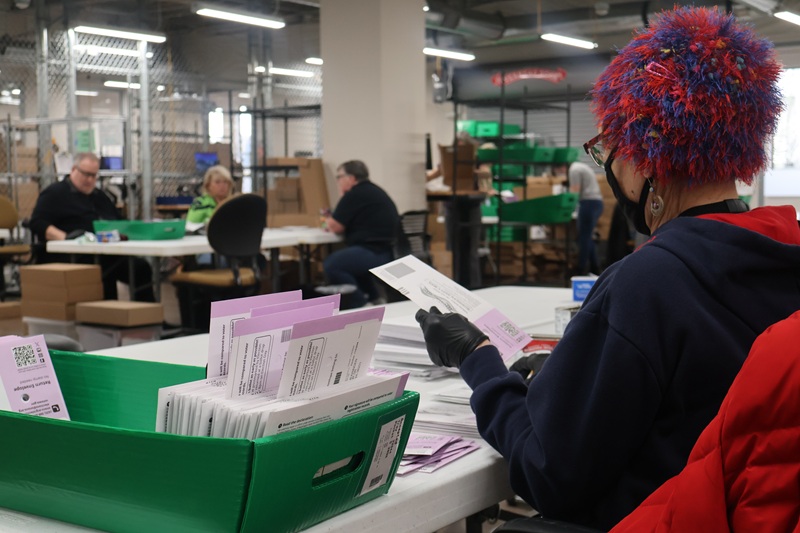
Voter ballots arrive in two ways: through the Postal Service and from drop boxes. Mailed ballots are trucked to the Seattle processing and distribution center and delivered to the county elections office at around 5:30 a.m. each business day with security on hand.
In the secured Elections Office, incoming envelopes are run through a large state-of-the-art machine, scanning the voter’s individualized bar code on the envelope, the signature, date and other voter-provided information. They are then sorted into batches of 200, all recorded in sequence for each batch.
For those concerned about duplicate ballots, this machine is smart. If it encounters another matching bar code, it is captured for further action by staff.
Signature Verification
In another part of the office, trained staff compare envelope signatures with each voter’s registration card. If a discrepancy arises, a special group follows up with the voter. This explains why the email address and phone number on your return envelope is important.
Once the voter signatures are verified in each batch of 200, the ballots move to the next step in the process.
Ballot Preparation
Ballot preparation involves extracting ballots from the envelopes and preparing them for tabulation. A team of trained staff tackles the hundreds of 200-ballot batches.
For each batch, the ballots are removed from the secrecy sleeves, unfolded, inspected for any damage and/or additional marks or errors made by the voter. The most frequent damages to a ballot are ballot seam splits that need to be taped back together, ink splotches, and voters trimming the edges of the ballots like a shopping coupon.
Voter errors include crossing out a vote made and not filling in the ‘bubble’ next to the chosen name or write-in. These kinds of ballots are separated from the rest and placed in special folders that those in adjudication will inspect more closely to ensure each vote is counted.
The funny holes in the ballot envelopes and secrecy sleeves have a purpose. The holes ensure all materials are visually removed. At the end of the extraction process, the ballots are counted to ensure the same number of ballots are there from the start of processing each batch of ballots.
Per regulations, the envelopes are archived in a secure county warehouse for 22 months in case there is any need to review them for a recount or other legal reasons.
Tabulating the Votes
The final step in the process is in the adjudication ‘cage’. This area has the tightest security and is where ballots are scanned through tabulation machines.
The scanners use the dashed markings to center the ballot as it rolls through the scanner, capturing the image on both sides of the ballot. Those images are used to tabulate votes for each race. Write-in votes are also captured. The scanners tally the ‘bubbles’ filled in by the voter. Vote tabulations are saved in an ‘off the Internet’ set of servers, waiting for Election Night to be tabulated and reported just after 8 p.m.
For ballots that had any questions or issues, pairs of ballot evaluators sit next to each other, viewing these ballots on large computer monitors and determine what the voter intended.
The vote count offered on Election Night involves all the ballots received and processed by early voting. The remaining ballots received on or just before Election Day are processed during the rest of the week, adding to vote totals each day reported just after 5 p.m.
Visit the Elections Office
Want to see how ballots are processed? Have questions about the voting process? All voters are encouraged to visit the Snohomish County Elections Office and see the operation firsthand. Staff will guide visitors around the very transparent election facility, including each step of the process, and answer questions. This opportunity also goes for students who will someday become voters.
