
This article was updated to correct the number of Community Transit contractors transitioned to employment to 108 and clarify that fare structure following the adjustment period has not been defined.
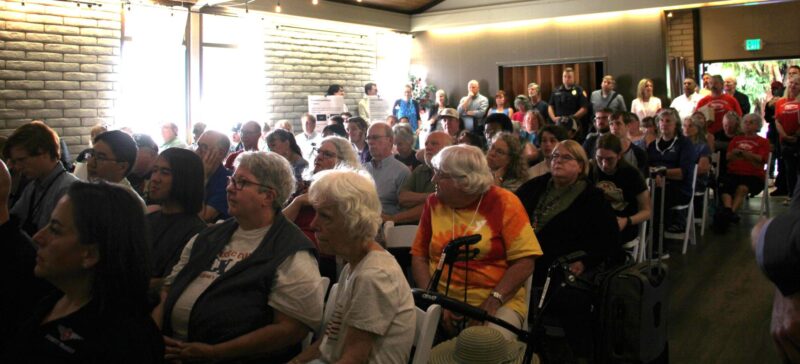
EVERETT — The City of Everett and Community Transit hosted a packed open house this week to connect with people hesitant and hopeful about the future of bus service. In recent months, Everett Mayor Cassie Franklin and city staff have advocated for Everett Transit’s annexation into the larger CT network to expand transit options and prepare for the incoming Sound Transit light rail extension.
Opponents of the merger, like long-time ET drivers and riders, say their primary concerns are a loss of local control and tax/fare increases initiated without a public vote.
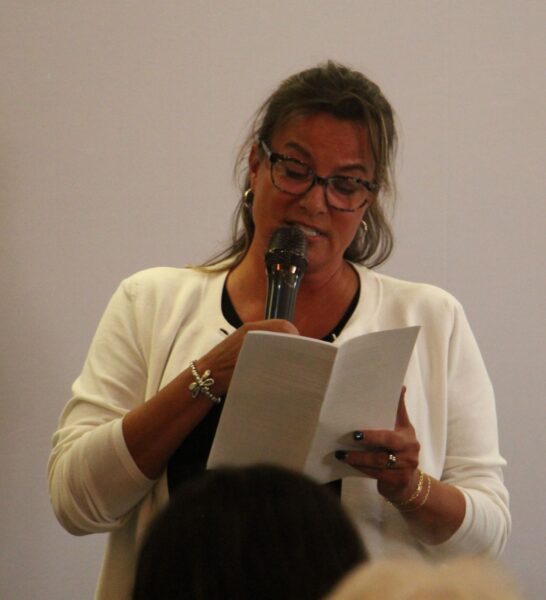
Franklin began by stating that she wished to acknowledge the discomfort felt by community members about the merger and discussed the primary motivators for the city’s decision to pursue it.
City-initiated studies show that the current level of service is already insufficient due to low frequency and limited route quantity. Drafted projections envisioning the consolidation include the following highlights:
- An additional five routes, bringing Everett’s service from 10 to 15 fixed routes.
- 14 routes with all-day service at least every 30 minutes, an increase of 11 routes with this frequency.
- 15 routes with service until 9 p.m. or later, extending hours for 12 possible routes.
- Improved regional connections that reduce transfers and access to surrounding communities.
- The addition of other service opportunities, such as the Zip microtransit.

A merger with CT could position the city for the light rail extension—which is currently planned to reach Everett sometime between 2037 and 2041. Everett Transit already intended to ask voters to raise the transportation sales tax from .6% to .9%. by 2030. This option would provide a 25% growth in service hours and an average reduction of 10 minutes in wait-time.
However, this plan still does not meet the anticipated need of a light rail community. Everett Transit’s current funding provides about 100,000 service hours. This would increase to 140,000 hours if the levy was approved. Infrastructure required to connect the light rail would require 200,000 hours. Franklin stated that Public Transportation Benefit Areas, such as CT, had more authority to tax than the city and, therefore, could afford larger-scale plans such as the light rail and its surrounding infrastructure.
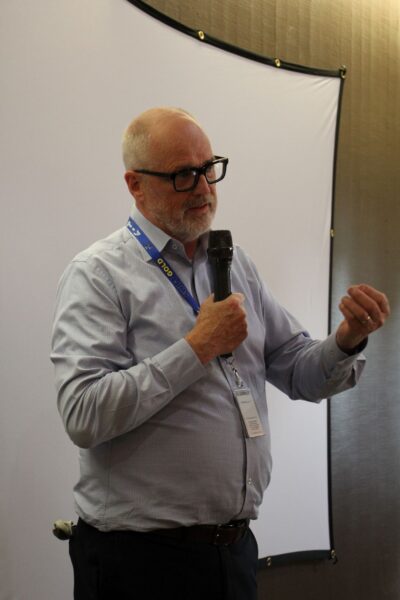
Community Transit CEO Ric Ilgenfritz reflected positively on the agency’s 50-year partnership with Everett Transit’s 50-year partnership but added that the agencies had route/service incompatibilities and redundancies.
After statements from Franklin and Ilgenfritz, attendees were invited to visit information stands and speak with city or CT representatives.
Opponents of the annexation detailed their concerns.

- Seniors will no longer automatically qualify for paratransit services. Everett Transit currently goes beyond ADA requirements by providing paratransit services throughout the whole of Everett. By law, transportation agencies are only required to provide paratransit service within 0.75 miles of fixed route bus services. Early objectors to the merger were concerned about the range of paratransit services being cut in this way but CT has agreed to continue this range of service. Paratransit users already registered with Everett Transit, including seniors without qualifying disabilities, will continue to receive this service.
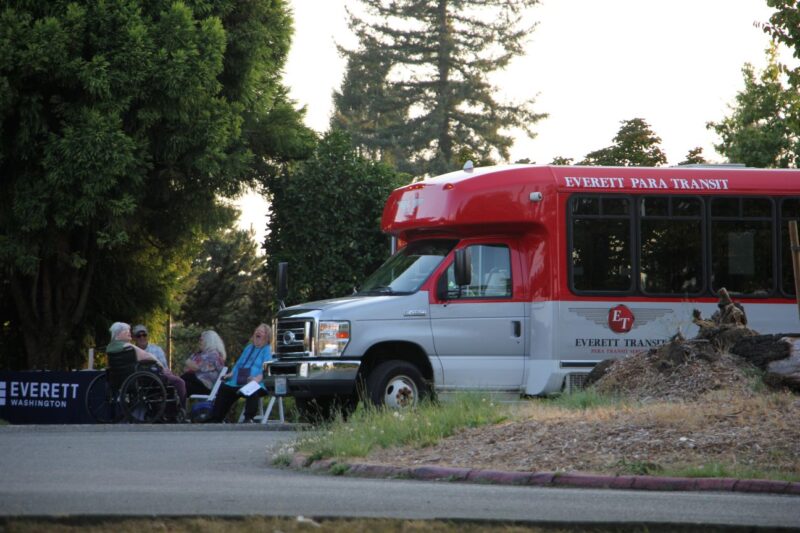
An Everett Paratransit vehicle parked outside the open house venue - Annexation would raise the transportation sales tax from .6% to 1.2% without a vote of the public. Drivers such as Karl Neue-Lawson said they would be willing to support the merger if the public voted in favor of it. The deadline to place a measure on the November 2026 ballot has passed, meaning that any vote would have to be held in future years. However, the only authorization required is that of the Everett City Council. State legislation passed in 2025 (SB5801) allows PTBAs to annex local transit agencies if the city’s governing body agrees to it. In response to criticism over the lack of vote, City of Everett Communications Director Jason Kelly responded “The mayor, in general, believes she and the city council were elected to govern the city using the tools at their disposal. In the case of the transit merger, the state legislature provided this tool to allow the Community Transit Board and the Everett City Council to agree to annexation.”
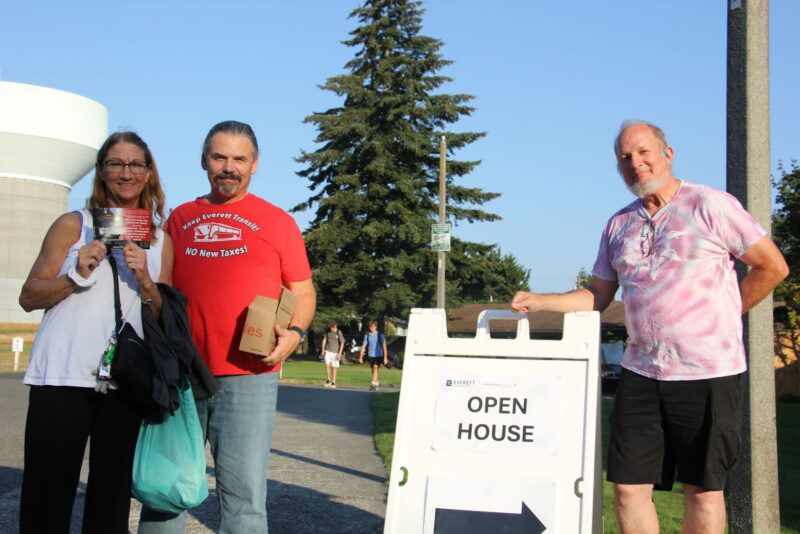
“The people who can least afford [transit] are those most impacted,” said long-time rider Joanie Oxentenko, who credited Everett Transit drivers with getting her through homelessness in years past. When asked if other income sources were considered, CT representatives stated that, by Washington law, PTBAs were only permitted to utilize sales tax for funding.
- A loss of local control could lower the quality of service that riders receive. Everett’s population qualifies the city for a seat on the CT Board of Directors. While this would allow some measure of local input into CT’s decision-making process, it would lose the absolute control the city currently has over its own transit agency. Highly localized responses, such as the elimination of fares on route 12 when the neighboring grocery store was closed, would require authorization that Everett’s representative cannot control.
- During an adjustment period of approximately one year fares will remain at Everett Transit’s current rate. If CT’s standard rate is utilized follwing the adjustment period, standard fixed-route service would increase from $2 to $2.50. Fixed-route reduced fares would stay the same at $1. Everett Transit currently provides an additional discount for seniors and disabled riders for fixed-route service at 50 cents, which would increase to $1 under CT guidelines.
- Everett Transit employees are concerned about the future of their employment. By law, CT is required to fulfill the bargaining contracts currently in place. The breadth of this concern ranges significantly. Some were concerned about bureaucratic or uncaring management, while others were concerned about losing their seniority and/or autonomy. Others were concerned they would lose employment entirely after their union contracts expired. CT recently transitioned approximately 108 fixed-route drivers from contracted employment to in-house employment but the agency’s use of contracted employment—particularly for its DART paratransit service—was a major concern for union employees.
A date has not yet been announced for the merger’s consideration and vote by the Everett City Council. A discussion of other Everett Transit matters and the agency’s 2025 report is scheduled for the council’s Aug. 26 meeting.