
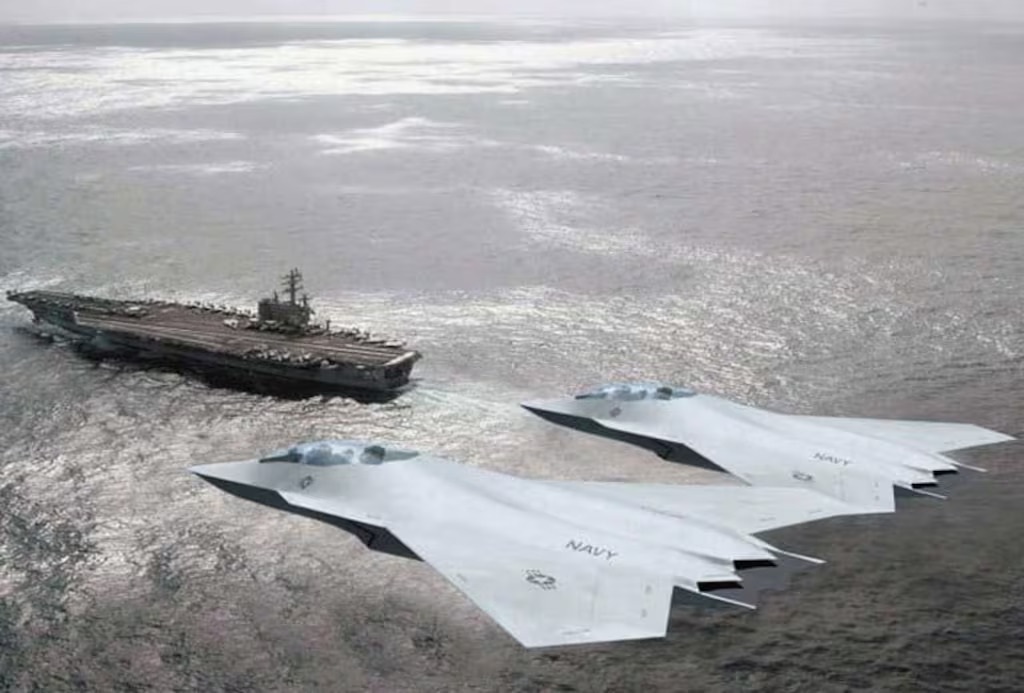
WASHINGTON, D.C. — Boeing has been awarded a $20 billion defense contract to develop the next generation, carrier-based strike fighter jet for the U.S. Navy, the Department of War announced, one year after winning an Air Force fighter jet contract.
Boeing will develop the Sixth-Generation F/A-XX Strike Fighter, procuring multiple test aircraft for ground, airworthiness, systems and weapons integration testing. The fighter will revolutionize advancements in open mission systems architecture, advanced mission systems and operational reach and capacity, Boeing said after the announcement.
The F/A-XX will provide advanced carrier-based power projection that extends the range of the most agile and survivable airfields: U.S. Navy carriers, the Pentagon said in a written statement. In addition, F/A-XX will be interoperable with manned and unmanned platforms such as Collaborative Combat Aircraft (CCA) and increase the capability of every CCA it teams with under the Next Generation Air Dominance (NGAD) program. The technical and programmatic details of F/A-XX remain classified under U.S. national security and export laws.
“It’s an honor to be selected to produce the Navy’s first sixth-generation platform. Backed by decades of work, bolstered by game-changing innovations and solidified by the investments we’ve made in new facilities uniquely suited to build multiple products with next generation capabilities, our dedicated and talented team is ready to execute this critical program,” said Steve Parker, president and chief executive officer, Boeing Defense, Space & Security.
“The F/A-XX is a critical pillar in our commitment to maintaining peace through strength. F/A-XX will dominate contested airspace, extend operational reach, and deliver a decisive combat advantage for the warfighter,” said Michael P. Duffey, Under Secretary of War for Acquisition and Sustainment. “The F/A-XX platform represents a crucial, non-negotiable investment in America’s national security and long-term air combat capabilities. We are joining forces with Boeing to field these capabilities rapidly, ensuring our warfighters possess the lethal and highly networked systems required to deter aggression, project undisputed power, and secure absolute air superiority.”
Boeing will deliver the platform beginning in the 2030s to augment and eventually replace legacy F/A-18E/F Super Hornets and EA-18G Growlers and operate alongside the F-35C.
“This achievement marks a new era for the U.S. Navy,” said acting Secretary of the Navy Hung Cao. “The Sixth-Generation fighter is a generational leap in air superiority and will provide the world’s best aviators with unparalleled capabilities to fight, win, and come home safely. We are excited to partner with Boeing, and for our warfighters to continue to dominate the skies and defeat our nation’s enemies.”
The Navy jet contract becomes Boeing’s second consecutive major defense contract victory on fighter jets. Boeing beat out rival Northrop Grumman Corp for the latest development contract which could grow to hundreds of billions over its lifetime as production ramps up and, potentially, as international customers place orders. The Sixth-Gen Navy jet is seen as pivotal in maintaining air superiority as China’s military attempts to expand.
Boeing was selected to build the Air Force’s new F-47 fighter in 2025, giving it two lucrative sixth-generation jet contracts in consecutive years. “Delivering two advanced fighters in parallel was always our plan, and we invested accordingly. We are ready and able to build multiple concurrent future combat aircraft franchise programs,” said Parker.
St. Louis, Missouri serves as the primary development and production hub for Boeing defense fighter jets, anchored by the Boeing Defense, Space & Security headquarters and dedicated manufacturing campuses. Construction continues on Boeing’s secure manufacturing facility, the largest in the U.S. Located in St. Louis, the facility will be part of the world’s most advanced, all-digital aerospace design and manufacturing system. “Investment in facilities is just one part of the story; we’re also investing in technology and people so that we can deliver for our customers,” Parker added.