
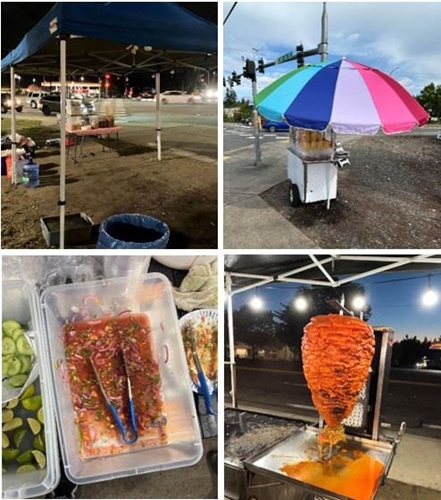
EVERETT, FEB. 9: The City of Everett is considering an ordinance that would crack down on unlicensed mobile food vendors operating within the city.
The ordinance proposed late January would provide regulation and enforcement guidelines for unlicensed mobile food vending units that violate food safety and Snohomish County regulatory guidelines.
The issue of unpermitted food vendors is one that Washington state has been trying to address for the last few years. In 2022, there were 16 Unpermitted Roadside Stand Food Complaints made in Snohomish County. Last year, the number rose to 203.
The Snohomish County Food Safety Program, operated by the county health department, can investigate complaints and deliver cease and desist notices, Jeff Hodson, health department communications manager wrote in an email.
“The main challenge is lack of enforcement authority and the length of time and amount of resources it would take to pursue civil action against vendors,” Hodson wrote.
Businesses that receive a cease-and-desist order are posted on the county health department website for up to 90 days and are temporarily closed. Out of 15 listed as of Monday, Feb. 9, eight are located in Everett.
The county has initiated a plan to work with regional partners and cities to address enforcement.
If approved, the Everett ordinance would enable law enforcement to fine or arrest unlicensed vendor operators and confiscate equipment. However, according to ordinance proposers, education on correct permitting and regulations would take precedence.
“This ordinance will provide city staff with an effective tool to not only educate unpermitted and unlicensed mobile food vendors, but also take enforcement action if they continue to repeatedly operate in violation of city and county codes, which is exactly what we’re seeing today,” Dan Templeman, senior executive director for the Mayor’s office said during a briefing of the ordinance, Wednesday, Jan. 28
Unpermitted vendors pose a risk to public health, the county health department has said. Permits and licenses require vendors to adhere to food safety regulations.
To tell if a vendor is safe, permitted food vendors are required to be displayed for customer viewing. Customers can also request to see the permit if one is not visible and can look up permitted food establishments and inspection reports on the county health department website.
Vendors that officials have approached have proven to have a lack of proper sanitation and inadequate food storage, officials shared during a presentation last month. Health department officials have found cooked meat sitting at 70 degrees Fahrenheit, below the safety standard of 120 to 130, allowing bacteria to grow, Templeman said.
Several jurisdictions across the county have also seen grease waste dumped down storm drains. Many vendors are additionally set up in public rights-of-way, impeding sidewalk usage.
Besides health and environmental concerns, business owners have expressed economic unfairness.
“I‘ve spoken with many upset and frustrated community members, as well as county health department officials and city, county, and state law enforcement. And while all of these individuals and groups recognize the obvious public health and business fairness concerns that arise with this type of operation, none of them have yet figured out a real, effective way to address this problem,” Templeman said.
There are two levels of penalties proposed in the ordinance, one for employees and then for employers.
Employees could see a maximum of 90 days in jail with a $1,000 fine if determined to be working for a vendor with incorrect permitting. However, rarely does anyone see a maximum sentence and fine, Assistant City Attorney Lacy Offutt said during the briefing.
As for employers, they would be charged with a gross misdemeanor, up to 364 days in jail and a $5,000 fine.
The council will vote on the ordinance on Wednesday, Feb. 11.
