
MONROE — A $382 million bond levy to build a new hospital in Monroe will go to voters again on the November 3 general election ballot because it’s unlikely to pass with the required 60% approval in this week’s primary election.
Lisa LaPlante, Chief Administrative Officer of EvergreenHealth Monroe and Superintendent of Snohomish County Hospital District No. 1, tells EverettPost.com, “While the election results aren’t what we hoped, we are extremely thankful to our entire community and every one that voted”. This week’s $382 million ballot measure, Proposition 1 for Hospital District No. 1, currently has a 55.69% ‘approve’ vote but requires a 60% supermajority to pass as a bond measure. Prop 1 was approved for the primary election vote by the hospital district’s five commissioners.
LaPlante says, “The board has made the decision, we have already put in for the November ballot to continue to pursue this (levy) because we feel it’s so important” to pass new hospital funding. The decision to try again on the November ballot was made in advance of the August primary as precaution to the possibility of voter rejection.
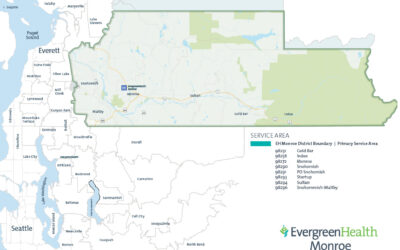
Hospital District 1 encompasses the Snohomish, Maltby, and Monroe areas eastward through the Skykomish River Valley to Index. The $382 million price tag for 30-year bonds to finance a new hospital facility in Monroe would cost property owners an average rate of $40.75 per month for a home or business with an assessed value of $745,000. The proposed levy rate is $0.437 per $1,000 of assessed value over the life of the bonds, according to the district. Exemptions from taxes may be available to certain homeowners that qualify based on Snohomish County Assessor criteria.
LaPlante acknowledged the tax burden in her interview with the EverettPost.com, saying, “We’re trying to think of every possible scenario and what we can do to make sure that we’re able to continue to grow and trying to do it the most efficient way for the taxpayers.”
As the $382 million bond measure is short of approval by just over 4%, LaPlante says, “We’re really encouraged, actually, because, even at–I think we’re at–55.6 (% yes vote) right now, that’s really strong. That’s a lot of support from our community and in this election with the primary, there weren’t that many returns.” As of yesterday, the voter turn-out for the bond measure within the hospital district is 25.64%. The voter turn-out for all of Snohomish County is slightly lower at 24.95% after two rounds of ballot tabulations.
With the strategy shifting to the November general election ballot, LaPlante continues, “So we’re very hopeful that we can reach maybe some people that weren’t aware or just didn’t vote this round and really educate them on the need for this. It gives us another three months to really be out there educating as much as we can. Just really trying to get that word out there and answering anyone’s questions on why we’re doing it this way.”
The $382 million bond measure would replace Monroe’s current hospital operating in a 100-year-old building that has had some prior upgrades, which LaPlante says is too expensive and confined to remodel. “We’re very limited in our ability to grow where we’re at,” LaPlante says, noting railroad tracks that border part of the current hospital property.
Those limitations are addressed in the $382 million hospital bond measure approved by the hospital commissioners, says LaPlante. “What was nice about this plan is–and we’ve been working on it since 2023–it actually allows us to exist in the current space. None of our services would be disrupted and we’d be able to build right next to existing sites. Don’t have to buy property or anything. Build right next to it. Transfer patients over. Turn off the lights at the old hospital,” as the new hospital opens for service, she says, if voters eventually comply.
The current hospital regularly exceeds capacity, LaPlante reports, ticking off the numbers, “We have a 14-bed emergency department. We have three ORs (operating rooms). We have 26 inpatient rooms. And that’s the problem.We are mostly at capacity. We are currently seeing through our emergency department with those 14 treatment beds, we’re seeing between 60 and 80 (patients), and usually it’s towards the 80 (patients) in a day.”
That means, “We end up having to care for patients in our hallways”, when hospital rooms are full, says LaPlante. “We provide excellent high-quality care, but that’s not the best situation for the patient for our staff or for really anyone.”
When the existing hospital is packed at that level, it can mean injured or suffering patients decide to go to Everett or Kirkland facilities in the hope for faster treatment. LaPlante cites the uncertainty of travel times on US-2 or Highway 522 for patients being driven to other hospitals, adding to the wait time for treatment and medical attention, “Whenever you can receive care locally, everyone knows that’s better for the patients and their loved ones.”
Combine that patient capacity factor with the growth in medical treatment for the Monroe hospital’s service area, and LaPlante laments this week’s bond measure failure at the ballot box, “The need does not go away. It continues to rise. The demand (for patient capacity) rises. And we want to continue to keep patients local.”