
NORTH SOUND, JAN. 29: The mid-winter dry streak is over. Light rain fell over much of the North Sound overnight Tuesday. At Everett-Paine Field, a grand total of three hundredths of an inch fell, breaking the stretch of 14 dry days in a row. The all-time record-long mid-winter dry stretch at Paine Field was set just last year at 15 days.
Below average rain this month
After a wet start to the month, the 14-day period of dry weather has resulted in below-average rainfall across the North Sound. As of Wednesday morning, Everett – Paine Field has had just 1.72 inches of rain this month. The average for the entire month is 3.41 inches.
Monroe has received 2.93 inches this month, well below the monthly average of 5.75 inches.
Big change to wetter weather
The big ridge of high pressure that steered Pacific weather systems well to the north for two weeks has weakened and moved inland. That change has allowed the first of several weather systems to swing ashore. Additional systems will spread rain into the North Sound at times through this weekend, though Saturday, Jan. 31, looks like there will be a break in the rain. Expected rain amounts, however, will likely not be enough to make up this month’s rain deficit.
Temperatures are expected to rise above average as well. High temperatures will warm into the 50s with lows only dropping into the 40s. The average high in late January is in the upper 40s.
Mountain snow status
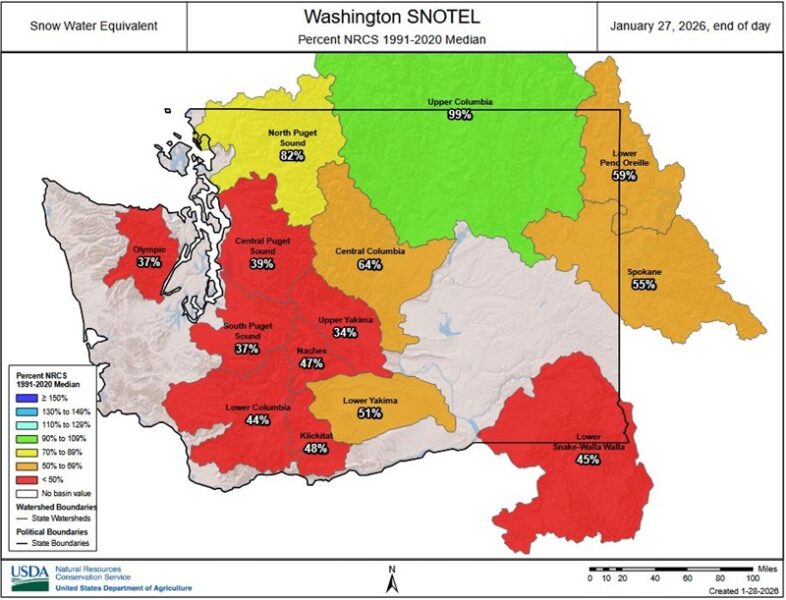
The mountain snowpack was well below average before this period of dry mid-winter weather. At mid-month, the NW Avalanche Center reported the Olympics and Cascades were only ranging from 40 to 55% of average snow depth. And no snow had fallen until overnight Tuesday and early Wednesday, and that snow has been quite light.
The Natural Resources Conservation Service monitors the amount of water in the snowpack and reports that water content has ranged from 35 to 45% of average, with the exception of around 80% in the North Cascades.
The weather systems arriving through this weekend are expected to drop some much needed snow in the mountains. Snow levels are expected to be around 4,000 feet to start, but by Thursday and through the weekend, are forecast to rise between 5,000 and 6,000 feet. So any accumulating snow will be limited to higher elevations.
Upper high-pressure deja vu
The return of rain across the North Sound looks to be short-lived. Weather forecast charts show the return of high pressure aloft over the Pacific Northwest early next week, once again steering Pacific weather systems away from the region. This weather pattern will likely keep the North Sound and the mountains dry for the rest of next week.
This return to dry and mild weather does not bode well for the mountain snowpack through at least next week. The snowpack usually reaches its peak around April 1st, leaving less than two months to make a return to at least average.
Heading into early February, temperatures also look to be unseasonably warm. Some North Sound locations could crack the 60 degree mark, giving an impression of an early spring. Daily record high temperatures at many North Sound sites this weekend and next week are in the upper 50s and lower 60s.
Longer range outlooks through much of February fail to offer any significant cooler and wetter weather. The odds favor warmer than average temperatures and near or below average precipitation.
Impacts
Unless there is a big change to cooler and wetter weather later in February and March, there will likely be limited water supply later this summer and fall.
Impacts include not having enough water for electric power generation, irrigation water, particularly for Eastern Washington agricultural areas, water for fish and recreation, and even consumer water supplies could be impacted.
The wildfire season could get off to an earlier-than-usual start for the entire Pacific Northwest and Western Canada. Wildfires also mean yet another threat of smoke and poorer air quality in the North Sound.
Enjoy the refreshed air quality thanks to the rain through this weekend. The region just needs more of it heading into spring.
