
EVERETT — As we commemorate Veteran’s Day and show our indebted gratitude to the women and men who have selflessly put their lives on the line to protect and defend freedom both in the United States and around the world, the stories of the seven naval destroyers and Coast Guard buoy tender homeported at Naval Station Everett, provide valuable lessons of history and valor for civilians.
Veteran’s Day in America stems from Armistice Day, a ceasefire that ended World War I–known at the time as “The Great War”–before the Treaty of Versailles was signed on June 28, 1919, in the Palace of Versailles outside the town of Versailles, France, officially ending the war. That ceasefire, announced by the Allied nations and Germany, went into effect on the eleventh hour of the eleventh day of the eleventh month. For that reason, November 11, 1918, is generally regarded as the end of “the war to end all wars.”
The national day to honor and uphold America’s veterans for their patriotism, love of country, and willingness to serve and sacrifice for the common good originally called for a day observed with parades and public meetings and a brief suspension of business beginning at 11 a.m.
In November 1919, President Woodrow Wilson proclaimed November 11 as the first commemoration of Armistice Day with the following words: “To us in America, the reflections of Armistice Day will be filled with solemn pride in the heroism of those who died in the country’s service and with gratitude for the victory, both because of the thing from which it has freed us and because of the opportunity it has given America to show her sympathy with peace and justice in the councils of the nations.”
An Act of Congress (52 Stat. 351; 5 U. S. Code, Sec. 87a) approved May 13, 1938, made the 11th of November in each year a legal holiday—a day to be dedicated to the cause of world peace and to be thereafter celebrated and known as “Armistice Day.” Armistice Day was initially a day set aside to honor Veterans of World War I, so after the conclusion of WWII, Congress, in 1954, expanded the designation of the holiday to Veterans Day, amending the original Congressional bill to replace “Armistice” with “Veterans,” officially broadening the holiday to honor American veterans of all wars.
Naval Station Everett crystalizes the significance of Veterans Day with the estimated 6000 active-duty sailors and Coast Guardsmen working across various base commands and assigned ships. The names of the seven destroyers carry an irrevocable legacy for the naval leaders they’re designated after and the sailors who have expertly served on them.
The USS Barry (DDG 52), named for John Barry (1745 – 1803), an Irish-born American naval officer who served in the Continental Navy during the American Revolutionary War and eventually the United States Navy. He has been credited by some as “The Father of the American Navy”, sharing that moniker with John Paul Jones. Barry was appointed as a captain in the Continental Navy on December 7, 1775. Barry was the first captain placed in command of an American warship commissioned for service under the Continental flag. After the Revolutionary War, he became the first commissioned American naval officer, at the rank of commodore, receiving his commission from President George Washington in 1797.
At the break out of hostilities between England and the American colonies, he offered his services to the Continental Congress. His ship, Black Prince, was purchased by the colonial government and was renamed, Alfred. Later, on December 3,1775, with John Paul Jones as a lieutenant, Alfred first hoisted the American (Grand Union) flag in Philadelphia.
Captain Barry was given command of Lexington on 7 December 1775. Lexington sailed March 31, 1776. On April 7, 1776–nearly four months before the Declaration of Independence–off the Virginia Capes, she fell in with Edward, tender to the British man-of-war Liverpool, and, after a desperate fight of one hour and twenty minutes, Edward was captured and brought into Philadelphia as a prize. Barry continued in command of Lexington until October 18,1776, during which time he captured several private armed vessels.
On May 29, 1781, after several hours of fighting, Barry captured H.B.M.S. Atlanta and later Trepassy. Barry was wounded during the engagement with Atlanta. He continued in command of Alliance and captured numerous prizes in 1782.
In March 1783 the last naval engagement of the Revolutionary War was fought by Barry in Alliance against the British man-of-war Sybylle. Though the ship surrendered to him, he was obliged to abandon his prize to escape the rest of the British squadron. At the time of the fight with Sybylle, Barry was convoying Duc de Lauzane, carrying money and supplies from the West Indies to the United States. His action enabled Duc de Lauzane to escape and reach port safely.
Four naval ships have been named after John Barry, Barry I (Destroyer No. 2), Barry II (DD-248), Barry III (DD-933) and the current USS Barry DDG 52 homeported at NSE.
John Paul Jones, like Barry, is considered the vanguard of the U.S. Navy. Jones was born John Paul on July 6, 1747, in Scotland. At the age of 12 he entered the British merchant marine and went to sea for the first time as a cabin boy.
He became first mate on a slave ship in 1766, but soon left that trade in disgust. In 1773, he killed the leader of his mutinous crew in self-defense at Tobago, in the West Indies. To avoid trial, he fled to Virginia and was considered a fugitive by the British. He concealed his identity by adding the surname Jones.
At the outbreak of the American Revolution in 1775, Jones went to Philadelphia and entered the Continental Navy. He served with Barry on the Alfred and was quickly promoted to captain in 1776. In command of Ranger in 1777 and 1778, he operated in British home waters and made audacious raids on England’s shore.
On September 23, 1779, Jones fought one of the bloodiest engagements in naval history with the 44-gun Royal Navy frigate Serapis. Although his own vessel was burning and sinking, Jones would not accept the British demand for surrender, replying, “I have not yet begun to fight.” More than three hours later, Serapis surrendered and Jones took command.
According to some historians, Jones remained appealing as much for his actions as for his personality. Early British novels portrayed him as a ruthless marauding pirate akin to Blackbeard. His attacks on British ships were often sudden and sometimes bloody. The vision of a swarthy scalawag persisted even to the writings of Rudyard Kipling a century later.
In Britain, his naval actions against the mother country certainly led to his reputation as a pirate. The USS John Paul Jones (DDG 53), currently homeported at NSE is one of five naval ships named for Jones. The USS Paul Jones (1862), was a sidewheel, double-ended steam gunboat that served in the Union Navy during the American Civil War from 1862 to 1867. The USS Paul Jones (DD-10), Bainbridge-class torpedo boat destroyer active from 1902-1919. The USS Paul Jones (DD-230), a Clemson-class destroyer commissioned in 1921, fought in World War II and decommissioned in 1945. The fourth vessel, the USS John Paul Jones (DD-932 / DDG-32), a Forrest Sherman-class (later reclassified Decatur-class) guided-missile destroyer commissioned in 1956, reclassified as DDG-32 in 1967, decommissioned in 1982, and expended as a target in 2001.
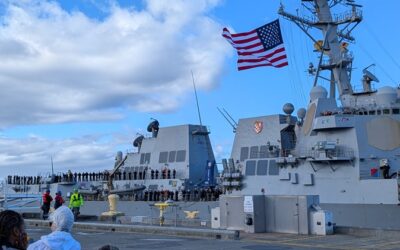
NSE’s USS Gridley (DDG-101) is named after Captain Charles Gridley, commander of Admiral George Dewey’s flagship USS Olympia, (Flag Captain) and recipient of Admiral Dewey’s famous command, “You may fire when you are ready, Gridley” in the Battle of Manila Bay during the Spanish–American War.
Four U.S. Navy ships have now been named in honor of Charles Vernon Gridley. USS Gridley (DD-92), was a Wickes-class destroyer, launched in 1918, decommissioned in 1922; USS Gridley (DD-380), was the lead ship of her class of destroyers, launched in 1936 and struck in 1947, USS Gridley (DLG-21), was a Leahy-class guided missile frigate, launched in 1961 and struck in 1994. In 1975, the Leahy class was redesignated as guided missile cruisers (CG), and she became CG-21.
Four ships in the United States Navy have been named USS Sampson for Rear Admiral, William T. Sampson (1840–1902), known for his victory in the Battle of Santiago de Cuba during the Spanish–American War. He assumed command of the battleship Iowa on June 15, 1897. On February 17, 1898, he was made President of the Board of Inquiry to investigate the destruction of the Maine. On March 26, 1898, he assumed command of the North Atlantic Squadron, with the temporary rank of rear admiral.
The first, USS Sampson (DD-63), was the lead ship of her class of destroyers, commissioned in 1916, served in World War I and decommissioned in 1921. USS Sampson (DD-394) was a Somers-class destroyer, commissioned in 1938, served in World War II, and decommissioned in 1946. USS Sampson (DDG-10) was a Charles F. Adams-class guided missile destroyer, commissioned in 1961 and decommissioned in 1991. USS Sampson (DDG-102) commissioned in 2007, currently homeports in Everett.
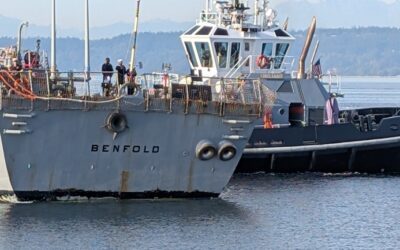
The USS Benfold occupies a unique space among the NSE ships on Veterans Day. Edward Clyde Benfold, born in 1931 to a father who had been a First Engineer in the U.S. Merchant Marine during World War II. The father was serving aboard the Honduran freighter Castilla on June 7, 1942, when it was torpedoed by the German submarine U-107 near Cuba. Benfold’s father was among the crewmen lost.
According to MilitaryTimes.com, Benfold, a boyish-looking 18-year-old enlisted in 1950, in the Hospital Corpsman Training Center and eventually trained as a neuropsychiatric technician, then qualified as a medical field technician in July 1951. He was deployed to the Fleet Marine Force, Pacific (FMFPAC) in Korea.
On Sept. 5, he was given a front-line assignment, operating alongside Company E, 2nd Battalion, 1st Marine Regiment, on a stretch of hilly frontage north of Panmunjom that the United Nations called “Bunker Hill.”
The high ground of Bunker Hill was pinpointed for occupation by the Chinese People’s Volunteer Army from Aug. 9 to Sept. 30, 1952. On Sept. 5, the Chinese launched their third and final attempt, only to be stopped dead by American firepower.
No less than three Americans who fought there were cited for the Medal of Honor: PFC Alford Lee Mclaughlin, using two machine guns and whatever other firearm was handy, held his outpost, killed an estimated 150 enemy soldiers and went on to retire in 1977; nearby, PFC Fernando L. Garcia, from Puerto Rico, leapt on an enemy grenade, giving his life to save his platoon sergeant; the third recipient was Benfold.
The corpsman was aiding comrades from an adjacent unit, Company I, 3rd Battalion and 5th Battalion, 1st Marines, when he came upon a crater near Outpost Bruce, and found two Marines there, badly wounded.
As he went to attend them, however, two grenades landed in his path, followed by the two charging Chinese who threw them. With seconds to make a life-or-death decision, Benfold snatched up both grenades, counter-charged the enemy and shoved the weapons into their jackets. The result was technically a violation of the corpsman credo, but Benfold’s act saved two wounded Marines at the sacrifice of his own life — and that of the enemy who would otherwise have killed them all.
Another corpsman, according to the Marine Corps Museum, was watching the events of the moment and rushed to aid Benfold. The damage from the explosions was too extensive, however, and Benfold died where he lay. On July 16, 1953, Rear Adm. John H. Brown, commandant of the 4th Naval District, presented the Medal of Honor to Benfold’s infant son. In addition, the corpsman received the Purple Heart, the Korean Service Medal and the United Nations Service Medal.
On Nov. 12, 1994, the newest guided missile frigate DDG-65 was christened USS Benfold.
The destroyer USS John S. McCain was originally named after John S. McCain Sr., and John S. McCain Jr., both admirals in the United States Navy. McCain Sr. commanded the aircraft carrier USS Ranger, during the latter stages of World War II. John S. McCain Jr. commanded the submarines USS Gunnel and USS Dentuda during World War II. These men were, respectively, the grandfather and father of Vietnam War Navy captain and later Senator John S. McCain III.
At a rededication ceremony on July 11, 2018, Senator John McCain was added as a namesake, along with his father and grandfather. The McCain’s nickname is “Big Bad John” and has the motto “Fortune Favors the Brave”.
The USS Sampson (DDG 102) honors William Thomas Sampson (1840 – 1902) was a Navy rear admiral known for his victory in the Battle of Santiago de Cuba the day before 4th of July in 1898 during the Spanish–American War.
Sampson served as Officer-in-Charge of the Naval Torpedo Station at Newport, Rhode Island. On September 9, 1886, he became Superintendent of the Naval Academy. He was promoted to captain on April 9, 1889, he commanded the cruiser San Francisco. Took command of the battleship Iowa on in 1897. Was made President of the Board of Inquiry to investigate the destruction of the Maine. in 1898 and secured the temporary rank of rear admiral in March 1898, as he assumed command of the North Atlantic Squadron.
The USS Kidd (DDG 100) is the third Navy ship named after Rear Admiral Isaac C. Kidd, who was on board USS Arizona during the attack on Pearl Harbor, and was the first American flag officer to die in World War II. He was the executive officer of the battleship Utah in 1925–1926, then commanded the Navy transport Vega until becoming the captain of the port at Cristóbal, Panama Canal Zone from 1927 to 1930. Promoted to the rank of captain, after three years at the Bureau of Navigation in Washington, D.C., he was the commander of Destroyer Squadron One, Scouting Force, in 1935–1936, stationed in Long Beach, California.
Kidd’s body was never recovered at Pearl Harbor and to this day he is considered missing in action. It is likely that he is one of the 900 men who are entombed in the ship. U.S. Navy salvage divers located his Naval Academy ring fused to a bulkhead on Arizona’s bridge. Kidd’s son, Admiral Isaac C. Kidd Jr., served in the US Navy from December 19, 1941, to 1978, eventually serving as Commander-in-Chief of the U.S. Atlantic Fleet. Kidd’s grandson Isaac C. Kidd III retired with the rank of Navy Captain.
The USS Kidd is the only active ship in the Navy officially allowed to fly the Jolly Roger pirate flag. To find out why, you’re obliged to click this link from military.com.
In March 2014, Kidd joined the search for Malaysia Airlines Flight 370 two days after it went missing over the South China Sea. Kidd was the second Navy ship to be deployed in the search, joining USS Pinckney.
The seven destroyers homeported at NSE are Arleigh Burke-class. Sampson, Gridley and Kidd are Flight IIA guided-missile destroyers. All others are Flight 1 DDGs.
Also based out of Everett is the USCG Henry Blake, (WLM 563), a 53-meter, Keeper-class buoy tender with a primary mission maintaining 80 lighted, 39 unlighted, and 65 shore-based aids to navigation in the Puget Sound area and along the coast of Washington. Secondary missions include marine environmental protection, search and rescue, and homeland security. Henry Blake is assigned to the Thirteenth Coast Guard District.
All 14 Keeper-class cutters are named after lighthouse keepers. Henry Blake’s namesake is the first keeper of the New Dungeness Lighthouse near Port Angeles, Washington. As she tends aids to navigation in her namesake’s former area of responsibility, Henry Blake’s motto is “Keeper of the Tradition.”
Henry Blake replaced USCGC Mariposa, which was decommissioned on 31 October 2000. According to Wikipedia, in June 2012 a yacht with four people aboard was reported on fire 20 miles northwest of Grays Harbor, Washington. Henry Blake, another Coast Guard vessel, and a helicopter were dispatched to render assistance. The yacht sank, but the three people aboard were rescued by a nearby fishing vessel with Henry Blake in support.
In August 2009, the ship participated in the clean-up of the Tatoosh Island lighthouse, which had been automated in 1977. Old generators, a fuel tank, and nine pallets of miscellaneous gear were lifted off the island by an HH-60 Jayhawk helicopter and set down on Henry Blake’s buoy deck so they could be hauled away.
In August 2022, Henry Blake was dispatched to the west side of San Juan Island where the fishing boat Aleutian Isle had recently sunk. The wreck was resting on the bottom below 61 meters deep. Nets from the vessel floated around the wreck, a hazard to both wildlife and the salvage operations which attempted to prevent a fuel spill. Using her crane, Henry Blake was able to recover over 430 meters (1400 feet) of nets from the wreck site.
From war time, to peace time, to emergency response, America’s U.S. military veterans are trained to respond in an instant and, if necessary, against the most formidable circumstances. The previouly mentioned Naval leaders and legends, combined with the array of vessels connected to the destroyer group simply homeported in Everett build an instructive spider-web of connects for just how hallowed and impressive the naval branch of the U.S. military is, let alone all of the branches of the U.S. military.
America and Americans are humbled and grateful for this level of dedication by our military veterans for the protection of America and protection of freedom loving people around the world. On Veterans Day, and every day of the year, remember and praise those military women and men who provide the protection that we so deeply adore and appreciate.