
EVERETT — The Port of Everett will pour $20 million into improvement projects in 2027 aimed at modernizing the commercial activity on the waterfront and greening the supply chain to support 35 individual projects and seven larger umbrella projects. The projects were part of the Port of Everett Commissioners approving a $72.5 million 2027 budget.
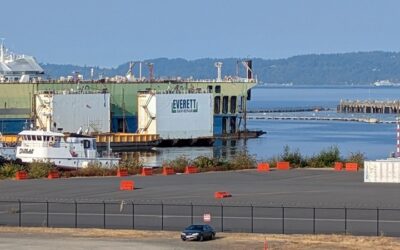
The Port Commission’s $20 million capital budget continues to build out destination retail and mixed-use amenities at Waterfront Place, upgrading and developing new Marina facilities, maintaining and preserving operating assets, improving the environment, and driving various economic development efforts. The totals represent the cumulative planned investments through 2031.
Monique Liard, Chief Administration and Financial Officer announced in a written statement, “The 2027 budget and financing plan reflect ongoing and anticipated financial implications resulting from current economic factors, including tariffs and uncertainty. The 2027 budget positions the Port to support economic development and jobs, aligned to present conditions, while being mindful of the needs of ongoing operations.”
The Port is budgeting total expenditures in 2027 of $72.5 million, consisting of:
- Capital investments of $20.1 million
- Operating expenses of $38.3 million
- Debt service and other obligations of $11.8 million
- Non-operating expense for public access and other costs of $1.5 million
- Contribution to cash and reserves of $0.8 million
The 2027 – 2031 Capital Improvement Plan includes 42 projects that advance the Port’s goal to develop the waterfront as a place of commerce, as well as a destination for citizens and guests to recreate, enjoy the views and atmosphere.
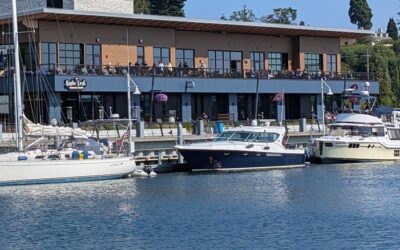
Liard says those projects are, “Investing in maritime infrastructure to support the efficient movement of commerce, while also greening the supply chain. Building out public infrastructure and mixed-use elements at Waterfront Place–including new destination retail and restaurants at Fisherman’s Harbor, and moving into development for the second phase at the Millwright District.” Liard adds that the 2027 plan also continues to recapitalize and upgrade Marina infrastructure, including dock upgrades.
Mukilteo will also play a leading role for the Port of Everett as it explores new economic development opportunities, such as waterfront redevelopment planning at the decommissioned tank farm site near the ferry dock. The Port will also address systematic cleanup of legacy contamination along the waterfront as part of the Puget Sound Initiative.
Each of these efforts, according to Liard, will require significant investment from the Port. The Capital Improvement Plan proposes $141 million through 2031. Operating Revenues are budgeted at $47.9 million, a decrease of 2.7% from the 2026 budget. These revenues will be used to pay for the Port’s direct operational expenses, including administrative overhead, of $38.3 million, an increase of 0.5% from the 2026 budget.
The operating budget reflects moderated activity at the Seaport, Liard says, such as strong moorage occupancy, full-year tenancy for several restaurants which opened in late 2025 and mid-2026, and increased employment and labor costs, including benefits. The preliminary budget assumes Non-operating Revenue of $15.5 million, primarily from property taxes. In 2026, the Port Commission authorized the Port’s second Industrial Development District (IDD) multi-year levy, to continue its economic development efforts in Everett and Mukilteo.
Nonoperating Expenses amount to $8.7 million, a 1.2% increase over the 2026 budget, driven by an increase in interest expense on outstanding debt as the Port refunded some of its existing obligations and issued new bonds in 2026. In addition to cash generated by on-going activities, the Port expects to leverage various grants and existing debt facilities totaling $9.1 million to fund its capital projects.
The Port of Everett economic activity supports more than 40,000 jobs and generates nearly $433M in tax revenue split by the state, Snohomish County and City of Everett. The Port has identified fiver areas for the 2027 capital improvements.
Seaport Modernization
Modernize and expand the Port of Everett Seaport to meet 21st Century infrastructure needs and support maritime opportunities • Mill A Cleanup • Equipment Upgrades • Electrification, Utility & Modernization Upgrades • Terminal Planning Total: $13.5M 2027 Expenditures: $7.9M
Maintenance & Preservation of Facilities
Provide for asset replacement, maintenance and preservation in Seaport, Marina and Real Estate divisions • Pier Strengthening • Refresh Buildings, Facilities and Equipment • Boat Launch Updates • Dredging Total: $47.5M 2027 Expenditures: $6.8M
Waterfront Community at Waterfront Place
Continuing investment in waterfront community, including primary infrastructure and commercial mixed-use developments Maintenance & Preservation of Facilities Provide for asset replacement, maintenance and preservation in Seaport, Marina and Real Estate divisions • Pier Strengthening • Refresh Buildings, Facilities and Equipment • Boat Launch Updates • Dredging Total: $47.5M 2027 Expenditures: $6.8M • Public Infrastructure Improvements • Millwright District Infrastructure Improvements • Public Open Space & Art Projects Total: $42.9M 2027 Expenditures: $2.3M
Sustainable Marina Operations
Develop and implement a comprehensive Marina services plan to ensure success of Marina operations and funding for recapitalization • Reconstruct Central A Dock • Reconstruct Guest Dock 1 • Marina Upgrades Total: $17.6M 2027 Expenditures: $1.2M
Economic Development & Other Projects
Expand the Port’s lease portfolio and enhance under-utilized real estate • Mukilteo Waterfront Planning • Planning, Permitting and Other Development Initiatives Total: $19.5M 2027 Expenditures: $1.9M
Two unique Port projects are already underway heading into 2027. The first is Pier 3 electrification. The Port is establishing shorepower to Pier 3 at its Seaport, marking a key step toward reducing air emissions and improving operational efficiency for the biggest ships. Electrifying Pier 3 will allow Seaport users to use electricity rather than solely rely on diesel engines or generators at the pier. This investment is expected to significantly reduce greenhouse gas emissions, improve local air quality, and further the Port’s commitment to sustainable maritime operations.
The Port Commission authorized a $2.6 million contract with Strider Construction in March 2026 and work is now underway. The project is funded by a state Department of Commerce grant and funding from Washington’s Climate Commitment Act (CCA). The CCA supports Washington’s climate action efforts by putting cap-and-invest dollars to work reducing climate pollution, creating jobs, and improving public health. Information about the CCA is available at www. climate.wa.gov.
The second electrification project in progress will establish vehicle charging infrastructure and acquisition of electric yard trucks at the Seaport. Yard trucks are used to move trailers, containers, and other cargo within the marine terminal. The Port was awarded $4.2 million from the Washington State Department of Transportation (WSDOT) through the Port Electrification Program to acquire and install electric vehicle charging infrastructure, make associated grid improvements, and procure fully electric cargo-handling yard trucks. Snohomish County PUD also awarded the project $350,000 for the purchase of an additional electric yard truck.
The Weyerhaeuser Company’s former Mill A site, located at the south end of today’s Port of Everett Seaport, is one of Puget Sound’s largest cleanup sites. This site was Weyerhaeuser’s first mill in Washington State and it operated for approximately 80 years — first as a lumber mill, then as a sulfite pulp mill, then as a thermomechanical pulp mill.
Ultimately, Weyerhaeuser ceased its operations at its former Mill A site because of its inability to meet newly enacted environmental standards, but not before Port Gardner Bay was contaminated. The Port is committed to ensuring the Bay is cleaned up. For more than a decade, the Port has been participating in an agreed order process with the Washington State Department of Ecology and Weyerhaeuser to conduct studies needed to determine cleanup options for the site that encompasses the Port’s South and Pacific Terminal berths.
In November 2024, following a public review and comment period, Ecology issued its final Cleanup Action Plan for the marine area portion of the site. The contamination that will be cleaned up stems from the former on-site saw and pulp mill operations. The Port is currently in litigation with Weyerhaeuser. The cost of the Ecology-selected cleanup remedy is estimated to be more than $200 million.
A final component of the 2027 budget is the Port Property Tax Levy. Under state statute, ports are special purpose districts tasked with economic development. While ports are a taxing authority, they are run and funded much differently than a general-purpose government (like a city or county) that is funded almost solely by tax revenue.
The Port of Everett’s regular property tax assessment is one of the lowest in Snohomish County, and is dedicated exclusively to capital projects, public access, and environmental remediation. This tax base represents only 8% of the Port’s total annual budget, with the remainder covered through Port business revenue or other funding sources such as grants, loans or financial tools available to public ports. In 2026, the Port Commission authorized creation of the Port’s fourth Industrial Development District (IDD) to cover the entire Port District, and use of its second IDD financing tool. The IDD will be established annually based on the Port’s capital funding needs over a multi-year period as permitted under RCW 56.36.160.
Ports are authorized to levy up to .45 cents per $1,000 on its regular tax levy; additionally, most ports are authorized for up to two IDD levies. Port tax for a $594,000 home in 2027 is projected to be $109.24 (or .1848 cents) for regular property tax and $172.32 (or .2901 cents) for IDD.
For 2027, total Port Tax collection total $14.8 million (20.4% of budget).
Port property taxes are not used for Port operating costs, including employee salaries/benefits. The Port says 82% of the 40,000 jobs its responsible for creating are in Snohomish County and the $433 million in state and local tax contribution helps fund schools, public safety and social services. This funding allows the Port to take an active role in restoring contaminated property, creating public access to the waterfront access, and supporting new economic growth.
Amid that economic growth is retail and commercial activity, which includes businesses who lease Port property to serve their customers. The Port utilizes a Leasehold Excise Tax where Port tenants pay a 12.84% Leasehold Excise Tax (LET) in lieu of property tax
In 2025, the Port collected approximately $2.6M in Leasehold Excise Tax
- The Port remits the tax collected to the State of Washington, which distributes to the correct jurisdictions.
- For every $1 of LET collected, the State of Washington receives 53 cents, the City of Everett receives 31 cents and Snohomish County receives 16 cents.
- The Port’s economic development activities generate high value for our city, county and state via jobs, revenues, income and taxes.
The Port of Everett operates three lines of business, international shipping terminals, marina facilities and real estate development. The Port operates eight shipping berths situated on approximately 125 acres of land and specializes in handling high-value, conventional and over-dimensional cargoes in support of the aerospace, military, construction, manufacturing, agriculture, energy and forest products industries. Most notably, the Port of Everett serves as an extension of the aerospace manufacturing process, accommodating all of the oversized aerospace parts for the 737 MAX, 747 (retired), 767, 777, 777X and K-C Tanker.