
EVERETT — Financial hardball has emerged in the city’s effort to build a proposed outdoor sports and concert stadium as Mayor Cassie Franklin announced a maximum price has been negotiated with the potential contractor for the new venue expected to keep the Aqua Sox baseball team in town.
The price lock is $72,897,293 for the stadium with the entire financing package totaling $144.6 million in a project that is expected to attract more than 400,000 visitors annually, generate approximately $85 million in yearly economic activity and support 660 jobs, according to city projections.
The basic math involves $54 million in upfront costs–call it the downpayment, with $30 million of that coming from the purchase of Everett Transit by Community Transit–and the remaining $90.8 million financed in 30-year bonds. Business and Occupation (B&O) tax collections, the team leases involving the Aqua Sox and United Soccer League team, naming rights and ticket fees will cover almost all of the projected annual $6.2 million in debt service the 30-year bonds will create.
Everett Finance Director, Chris Godwin, indicated the city would pay some of the construction costs up front and wait to do the Limited Tax General Obligation (LTGO) bonds until interest rates ostensibly drop to reduce the city’s debt service and limit the stadium’s over-all costs.
The Everett Outdoor Events Center project still requires City Council approval, which is expected to occur at its December 2 meeting. So far, it has accrued $40 million for property acquisition between Pacific Ave. and Hewitt Ave. on the east side of Broadway Ave.
The city’s stadium consultant, Ben Franz, reported Tuesday to the Everett City Council, the price of the “Original general contract estimate was overly optimistic,” prompting the newly stated guaranteed price.
Franz stressed an urgency to officially approve the EOEC to keep the costs on schedule. “It is really critical that we start construction on this project as soon as possible,” Franz told the seven councilmembers in his briefing. “If we were to lose another quarter (year) in overall time, we could easily see anywhere from 3-5% in increased costs. Again, we’ve negotiated that guaranteed maximum price, we’re holding on to bids to sub-contractors, but we cannot hold those indefinitely.”
Franz citied supply chain issues, data centers and diesel fuel prices for driving up the cost of the EOEC. He indicated diesel fuel prices have exploded 45% in Washington year-over-year, raising the construction cost to haul out debris when acquired buildings are knocked down for the stadium and hauling in new construction materials to be erected.
Supply chain for HVAC equipment and electrical wiring costs due to on-going data center construction demand around the nation, Franz explained, are increasing costs for other construction projects, like a potential EOEC, that need those items.
Dan Eernissee, Everett Economic Development Director, told the Council that instead of an existing 80-90 events a year at the city owned Angel of The Winds Arena, there could be 200 events combined annually. “And so that’s almost every day there’s something going on,” on either side of Broadway in the center of Everett. Eernissee added, if you combine those sports venues with downtown concert and theater facilities, “All of a sudden, now we’re creating an entertainment district,” in the heart of the city to “be a draw across the entire county.’
Franklin says, “This is a strategic investment in Everett’s long-term economic health. A stronger local economy helps us generate the revenue needed to support essential services and continue investing in our community. The Outdoor Event Center will help us build that future.”
The proposed $144.6 million budget covers the estimated cost of property acquisition, design, construction, public amenities and supporting infrastructure, the city said in a release. The City Council has already authorized approximately $20.8 million to advance the project. The proposed actions would authorize the remaining $123.8 million.
The identified capital contributions are:
- $42.4 million from City of Everett ($9.4 million already has been allocated)
- $7.4 million from State of Washington
- $10 million from Snohomish County
- $10 million from the AquaSox
- $7 million from USL
- $5 million from key business partners
Construction will require a $90.8 million line of credit, a short-term financing option; then, once the facility is completed, the city would convert to a longer-term financing option by LTGO bonds. Revenue to pay for debt service would come from multiple funding sources including tenant leases and contributions; naming rights; admission fees; and B&O taxes.
The city has also negotiated terms for a proposed 30-year agreement with its sports partners addressing operations, maintenance, revenue sharing and opportunities for community events.
The EOEC will be home to Everett AquaSox baseball and professional soccer, while hosting concerts, festivals and more than 100 additional events each year. The additional activity will benefit downtown restaurants, shops and hotels, encourage private investment and generate new tax revenue to help fund essential city services.
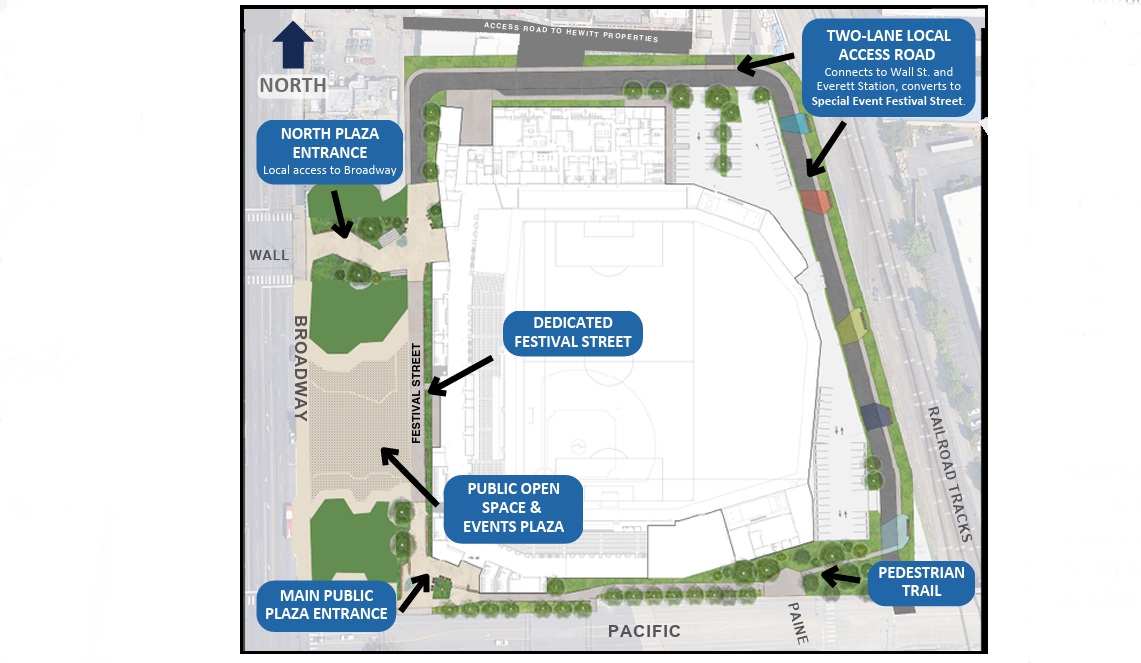
The project includes an urban park flanking Broadway, half-mile walking loop, public plazas and festival street, creating new spaces for residents and visitors to gather and enjoy downtown. By incorporating a park into a portion of the over-all project, the city can finance that portion of the project with a lower-cost bond for municipal construction rather than the for-profit construction the majority of the stadium would embody. Council will also consider a reimbursement resolution on Nov. 10 to support that part of the project’s financing.

Tuesday’s stadium presentation to the council included the disclosure that the baseball field will have a built-in, retractable pitcher’s mound. The 18-feet diameter mound would lower and raise in the middle of the baseball field to reduce that 10″ bump to quickly convert the infield to a level surface for soccer or concerts. It wasn’t immediately explained how the retracted mound would be covered to create a reliable, stable surface for soccer or athletic competitions that require an even playing field.
Construction is anticipated to begin following the necessary approvals, with completion targeted for 2028. The stadium contractor, Bayley Construction is headquartered on Mercer Island, Washington.
The stadium presentation from Tuesday’s city council meeting is embedded below.
alan
November 11, 2026 at 5:57 pmwho owns present land that AquaSox play on. what is its value before decision to be made