
EVERETT — More powerful, battery-powered vehicles that are simultaneously dropping in price, are prompting Everett officials to adjust city laws for electric motorcycles.
It’s a combination of new tech meeting public safety.
“Many more people have these devices than have ever had them before,” Everett assistant City Attorney, Hil Kaman, reported to the Everett City Council. “And with that has come an increased safety concern.”
The Everett Fire Department has responded to 49 electric-powered device injury calls in the last 12 months, according to city data. Everett ranks fifth for e-bike and third for electric scooter hospitalizations across Washington cities.
Washington Legislators just updated to state law to address electric motorcycles. Now Everett is crafting its own legal update. “What it does,” Kaman says of the proposed ordinance, “is it creates a new chapter for electric assisted bicycles and other devices that are not otherwise regulated. We already have a chapter for motorized foot scooters and our Parks code also has a chapter for electric bikes and electric scooters. We had to go back and amend those. The proposal is to amend those to make them consistent with the new chapter that we’re proposing for electric assisted bicycles.”
Washington State law (ESSB 6110) went into effect on June 11, 2026. It strictly separates legal, low-speed electric-assisted bicycles (e-bikes) from higher-powered electric motorcycles. It requires operators of high-speed, e-motorcycles to hold a valid driver’s license, a motorcycle endorsement, vehicle registration, and insurance.
“There has been a huge increase in access to electric bikes and other motorized electric devices,” Kaman advises. “A four-fold increase in sales on e-bikes in 2018 and 2022. 2.2 million e-bikes were imported last year, and youth biking has remained steady for about a decade, but it has increased by 15 percent due largely, largely caused by electric bikes.”
Risks to youth are especially concerning, he says, after investigating these trends to craft the new city laws. He found that e-bike crashes became the leading cause of pediatric trauma activations in the U.S., surpassing motor vehicle crashes, with e-bike–related hospital activations jumping from 2% of cases in 2017 to 64% in 2023. E-bike injuries among children and teens increased by over 300% from 2019 to 2023 and are now four times more likely to involve fractures or head injuries than accidents involving traditional bicycles.
“There are risks where bikes collide with pedestrians on sidewalks and trails,” Kaman alerted. “And one interesting fact that I discovered in this is that helmet use in electric bikes is significantly lower than regular biking. So, in e-bike and e-scooter hospitalizations, helmets were worn only 30 percent of the time. So, there’s a real need for us to inform the community and increase awareness about the risk of these devices due to their weight and their speed.
The recently enacted state law classified electric-powered motorcycles, bikes and scooters into three categories.
“This three-class system comes directly from state law,” Kaman explains. “Class One (I) is pedal assist; only the e-bikes right now, where the motor provides assistance only when you’re pedaling, and then the motor cuts off when the bike reaches 20 miles per hour.”
“Class Two (II) is throttle assist, so the motor can propel the bike on its own without pedaling, using the throttle, and it cuts off assistance at 20 miles per hour,” Kaman describes. “Class Three (III) is pedal assist, but in a combination of pedaling and motor, it can use the motor over 20 miles per hour.”
Kaman summarizes it like this for EverettPost.com, “The ordinance distinguishes between devices that go less than 20 m.p.h. on the motor alone and those that go more than 20 m.p.h. on the motor alone. For those that go under 20 m.p.h., (Class I and II electric assisted bikes, motorized foot scooters, etc.) riders can go anywhere bikes can go following the rules in the ordinance. For those that go over 20 m.p.h. (Class III electric assisted bikes, one-wheels, etc.), riders must ride in the street. Electric motorcycles are motorcycles and have no working pedals, can go more than 20mph on own power, and have motor power more than 750 watts. They are regulated as motorcycles. Electric assisted bicycles must be labeled showing Class I, II, or III.”
Electric motorcycles, like the Zero XB pictured above are capable of speeds up to 50 m.p.h. with their 7500 watt (7.5 kw) battery, according to the manufacturer. Pedal assist electric bikes that top out at 20 m.p.h. look like the model linked here.
And Kaman stresses, “Consumers should make sure they understand the capacity of any device when making a purchase.”
“A lot of what this ordinance does and what the state has done, Kaman boils it down, “is try and define what we’re talking about when we talk about electric assisted bicycles.”
Class III electric-powered motorcycles or bikes, Kaman says, “are restricted from sidewalks, and you have to be 16 years old (to drive them). They’re also prohibited from multi-use paths that cross multiple jurisdictions, so the Interurban Trail by state law does not allow Class 3 bicycles already. We then created two separate categories for all the other devices you might see. The reason we did this is because we don’t know what devices are out there. What devices might come along. We wanted to make something that was easy for us to enforce and easy for the public to understand.”
If the device can go over 20 miles per hour, Kaman says, you are limited to the roadway, the parking lots and private property and you must be 16 years of age or older.
“Under 16 (are) allowed only on class one and two e-bikes and other devices under 20 m.p.h.,” Kaman says. “Under 11 (requires) direct adult supervision and all riders under 16 must wear a helmet.”
If you’re 16 and over, Kaman says, “basically, you can get a driver’s license. We’re going to treat you like you are an adult. Helmets would only be required for Class III bicycles or any device that is in that powered personal transporter (category) over 20 m.p.h.”
That means operators who are 16 and 17 are treated as adults for traffic offenses and could be cited for tickets in Everett Municipal Court. The other regulation proposed is no sidewalk riding in the central business district. According to the proposed ordinance, that spans Pacific to Everett Avenue, West Marine View to Broadway “but not including the sidewalks on those main thoroughfares so that you could ride your bike down Pacific or Everett Avenue. It’s just within that box, you would have to walk your bike,” says Kaman.
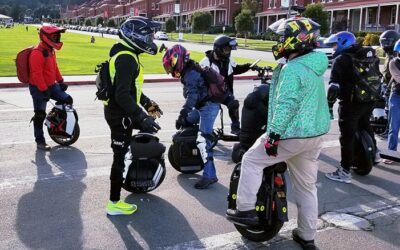
The desire for personal transportation at a lower cost for shorter distances, like the battery-powered motorcycles, bikes, scooters and one-wheels, is flooding the marketplace with options. Kaman says the improved technology at more affordable prices will create another new vehicle classification soon that will require another legal update for not just Everett, but other cities or the state. “There will be other things, I can guarantee. Somebody’s going to come up with something (vehicle) that we haven’t thought of yet.”
If this is passed, Kaman says, “we have a plan to do some public outreach. This ordinance is predominantly an information ordinance and not an enforcement ordinance. The police–everyone knows–there are limited resources. They’re not going to be out doing proactive enforcement, but they will be trying to inform the community about the risk that these devices, whatever regulations there are, and then have the ability through this ordinance to enforce against egregious violators for that. For behavior that is dangerous, puts people at risk.”
The Everett City Council will re-visit the proposed ordinance with a possible vote on July 15 or 22.