
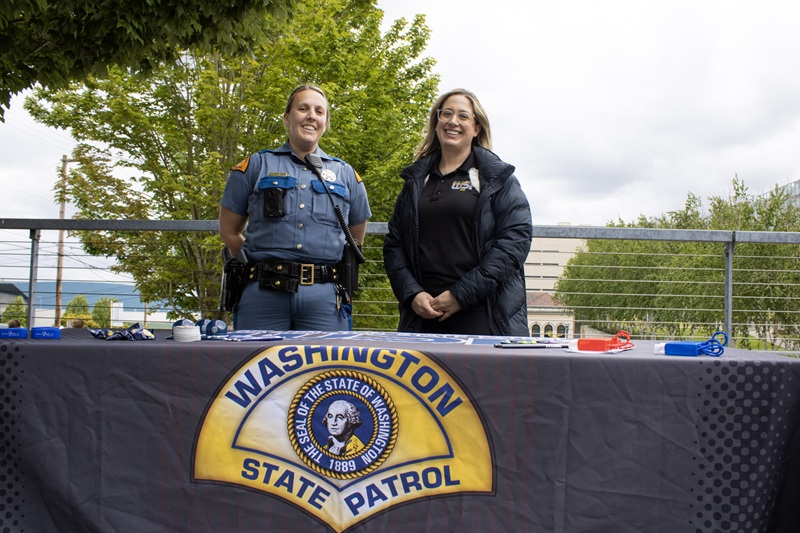
EVERETT, MAY 16: A binder, thicker than it should be, rests expectantly on a table at the Snohomish County Court Plaza Thursday.
Pages of missing person reports from Washington State Patrol (WSP) have been printed, showcasing faces of all ages in alphabetical order.
Leslie McPherson, Victim Support Services (VSS) Programs Administrator, said that the binder is in case someone had seen one of the people listed.
Every May in honor of Missing and Unidentified Persons month, VSS hosts an awareness event. This year, they set up a table alongside WSP at the Snohomish County Court Plaza on Thursday, May 15.
“The loved ones of missing persons experience significant emotional pain and uncertainty,” McPherson wrote in an email. “Awareness events can provide them with support, resources and hope for finding their loved ones. Increased awareness can also lead to more tips and information being shared with law enforcement, which can aid in investigations and increase the chances of solving cases.”
There are more than 910 open missing persons cases in the state. Washington is within the top 10 of states with missing persons cases, California being the state with the highest number of cases with 3,619.
VSS provides peer support and advocacy for individuals involved with a missing persons case. They are considered the oldest victim advocacy agency in the state and serve Snohomish, Skagit and Whatcom counties.
McPherson said that a lot of people don’t know about VSS or the organizations behind finding missing people. Unless someone is directly impacted, many don’t really care she said.
“This is why Victim Support Services hosts this event: to bring the community, loved ones of missing persons, and resources together to ensure that missing persons and those that remain unidentified are not forgotten,” McPherson wrote.
Misconceptions and advocacy
At any given time 2,000 people are missing in Washington State, Mary Margeson, Washington State AMBER Alert coordinator said.
Margeson said that the community holds a lot of misconceptions about the process behind a missing person’s case.
“The AMBER (America’s Missing: Broadcast Emergency Response) alert or the alerting process is generally handled by the state, that is how the legislation is written. But each individual agency is the investigating agency for the case,” Margeson said.
If a law enforcement agency has a case that fits the criteria for an alert type, they reach out to WSP, which goes through the process of activating the alert. But an agency is not required to report a case, even if it fits the criteria of an alert.
“If it is not written in their policy ‘when this happens then this,’ it’s a clarity thing within an agency,” Kelsey Harding, District 7 Public Information Officer said.
Another common misconception Margeson hears is that there is no waiting period to report a missing person to the police. You do not have to wait and should call 911 immediately, she said.
Victim Services Coordinator Janine Daniels-Moore works directly with families of a missing person, helping them with court cases to emotional support. Daniels-Moore helps coordinate financials, court hearings, and more for the victims of a missing person.
“The investigation process can be lengthy, and families may feel frustrated by the lack of communication and slow progress in finding their loved one,” Daniels-Moore wrote.
McPherson recalls a case of a mother whose son went missing three and a half years ago. The law enforcement agency in charge of the case presumed it a homicide. Despite it all the mother continued to spread information on her son, hoping to get some kind of closure.
“She has come to terms that it is a homicide. But her resilience has been so inspiring and she has been active in the community helping others who are searching for loved ones,” McPherson said.
Resources
Missing & Murdered Indigenous Women & People (MMIWP) Toolkit
