
WASHINGTON D.C. — Between chronic international conflagration in the Middle East, both sides of the Pacific Ocean and the Caribbean Sea, U.S. Navy sailors are being warned by Naval brass to prepare for deployments that last nearly a year rather than the typical seven-to-nine months as the military adjusts to protracted conflicts and fleet limitations.
Recently, the top commissioned and enlisted Naval officials warned sailors operational planning guidance is shifting to 10- and 11-month deployments for carrier strike groups, escorting destroyers, and embarked Destroyer Squadrons (DESRON), replacing the traditional 7-month target. Senior Navy leaders stated in late October that this extended timeline will likely remain the operational norm for the next several years due to global combat demands and fleet capacity limits
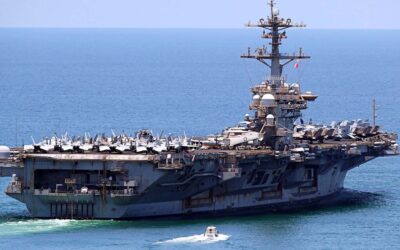
Chief of Naval Operations, Adm. Daryl Caudle said that the United States’ ongoing war in Iran has created a financial burden and logistical challenges regarding resupplying ships that have been deployed for long periods. “In the short term, until I can grow the Navy we need,” Caudle said in October, “I hate to admit it, but longer deployments are going to be probably part of that.”
The Navy’s top enlisted sailor, Master Chief Petty Officer of the Navy John Perryman, confirmed that a week later, saying 10-11 months will be the norm for at least a few years.
“Nobody wants an 11-month deployment. Everybody understands that,” Perryman said. “But what they really don’t like is getting told it’s seven months, and then every two weeks getting a change. It’s the uncertainty. They can’t plan for it.”
“I think sailors are willing to do extended deployments past the seven-month scheduled period, but they like to know what that extension’s going to be,” Caudle added, saying one of the “biggest hardships” that the service is looking to address is the “uncertainty” that extended deployments have on sailors and families.
“When sailors know how long they’re going to be away from family, they go plan their lives to that, and they can get all those events that would necessarily be in their life — from attending weddings to childbirth to family events to vacations — they know how to go build that into the schedule,” Caudle said in a Q&A session at Fort Meade, Maryland.
“But when I just basically extend in these (current deployments in) small chunks a little bit time after time, that brings a lot of uncertainty to families,” Caudle said about extending deployment for an aircraft carrier patrolling the Persian Gulf off Iran and the Strait of Hormuz this summer. “I’m working with that along with the other Joint Chiefs to try to get that more defined. I think that’ll improve going forward.”
Returning the fleet to predictable 7-month rotation schedules is expected to take a couple of years, according to military analysts.
For most of the cold war and post-Vietnam decades, standard carrier deployments were roughly 6 months. Shifting to eight-month deployments in 2013–2014, Navy leadership officially acknowledged that 6-month deployments were becoming the exception rather than the rule, formally transitioning target carrier schedules toward eight-month deployments to cope with operational demands and budget constraints.
In late 2023, deployments regularly stretched to 7, 8, or 9 months (such as the USS Dwight D. Eisenhower’s 9-month stint during Red Sea operations), setting the stage for the even longer 10-to-11-month schedules seen subsequently.

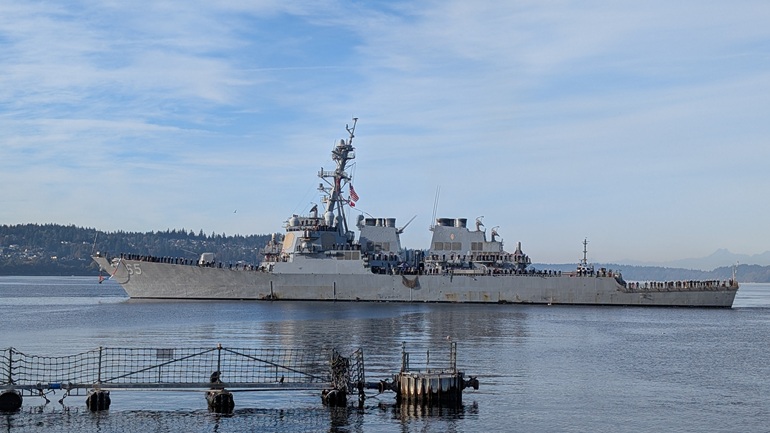
The Arleigh Burke-class guided-missile destroyer USS Spruance returned to its homeport at Naval Base San Diego on Nov. 13 after a 12-month combat deployment, the U.S. Navy said. The ship sailed more than 88,000 nautical miles across the 3rd, 7th, and 5th Fleet areas of operations. It participated in Operation Epic Fury, including Tomahawk strikes and maritime blockade enforcement near the Strait of Hormuz. The 357-day deployment is the longest for a U.S. destroyer since World War II.
Naval Station Everett is home to seven Arleigh Burke-class DDGs. The USS Benfold returned to port last month after an 8-month deployment.
Military attacks on Iran and the protracted reprisals that have ebbed and escalated all year long have garnered most of the global news attention on the northern side of the Arabian peninsula but security flashpoints continue on the southern side of the Arabian peninsula from Houthi rebels in Yemen threatening navigation of commerce through the Red Sea which serves as the short-cut to the Suez Canal and the Mediterranean Sea.
Opposite sides of the Pacific Ocean have experienced security priorities with Chinese naval operations on the western edge and international drug trafficking on the eastern edge, skirting Mexico. The narco-trafficking and security around Venezuela have impacted U.S. Naval obligations in the Caribbean Sea, too.
Combine that widespread activity and U.S. Naval capabilities are needed simultaneously for extended periods of time. Navy ships need maintenance, which requires time off-line at port, prompting available ships to patrol and defend for longer stretches of time.
Navy ship deployments operate on a structured, multi-year plan known as the Optimized Fleet Response Plan (OFRP), which runs on roughly a 36-month cycle that includes maintenance, basic and advanced training, and a final deployment phase.
Up until 2026, a typical Navy deployment lasted 6 to 9 months at sea. Because fleet presence must be continuously maintained, such as keeping aircraft carriers active around the globe, nearly every sailor assigned to a sea-going ship is expected to deploy as part of the rotation. Unlike soldiers or airmen who typically deploy to ground bases, tents, or local housing and return to standard barracks or off-base housing in between, single junior Navy sailors assigned to ships live permanently on the vessel—both out at sea and often while in home port. There is no “turning the ship off and going home” at the end of the day.
Naval deployment communication can be exceptionally difficult or restricted while underway at sea or submerged on submarines compared to land-based installations that maintain regular satellite or cellular connectivity.
For Naval Station Everett’s seven destroyers, they are deployed as the surface warfare command element alongside Carrier Strike Groups (CSGs), meaning DESRON staffs and attached guided-missile destroyers (DDGs) share the extended 10- to 11-month window. Independently deployed destroyers and Forward-Deployed Naval Forces (FDNF) based in Yokosuka, Japan, have faced even longer stretches ranging from 10 to 14 months
The Navy currently faces an insufficient number of active aircraft carriers and a slow shipbuilding and repair pipeline, meaning fewer ready ships are available to rotate into global hot spots. Extended deployments are compounding stress on naval hardware, requiring a “years-long recovery” and multi-million-dollar maintenance overhauls once vessels finally return to port including shipyard maintenance backlogs.
In light of the extra sacrifice and burden Navy sailors are now being asked to handle in these dire circumstances of international conflict and domestic policy consequences, a retired Navy Captain is urging the Navy to mitigate the impacts of “wear and tear” on both the sailors crewing these vessels as the vessels themselves.
Dr. John P. Cordle is a 1984 graduate of the U.S. Naval Academy and was a Navy Surface Warfare Officer for 30 years before retiring as a captain. He is a recipient of the U.S. Navy League’s Captain John Paul Jones Award for Inspirational Leadership, the U.S. Naval Institute Proceedings Author of the Year and the Surface Navy Association Literary Award. His new book, “Letters to Myself,” is available from Stone Tower Press.
He authored this message to Navy leaders to best prepare all involved on upcoming 300+ day deployments.
“The mental and physical “wear and tear” of 90-hour work weeks, often in a harsh environment (heat, noise and vibration) builds up layers of cumulative fatigue and stress. Sailors interviewed after completing long deployments during COVID reported increased levels of fatigue, stress and anxiety. They spoke of ‘droning’ — performing at the minimum level of engagement to ‘get by’ as if in a trance. Longer logistics chains mean less frequent mail and potentially less fresh and nutritious food, exacerbating the challenges to mental and physical fitness. Skipping or delaying health checks like mammograms, blood draws and other checks could increase risk for cancer or cardiovascular issues. The need for mental health support and increased thoughts of suicide are real risks. It is worth noting that the deployment is not the only time the sailors are away from home. Pre-deployment training, fleet support events and certifications require multiple extended underway periods, often weeks at a time, in the months prior to the actual deployment. The loss of Bahrain as a port visit in the Arabian Gulf region means long stretches with no port visits to relax, rest and reset are going to be the norm.”
To read the full essay by Cpt. Cordle (ret.), on Stars and Stripes, click here.