
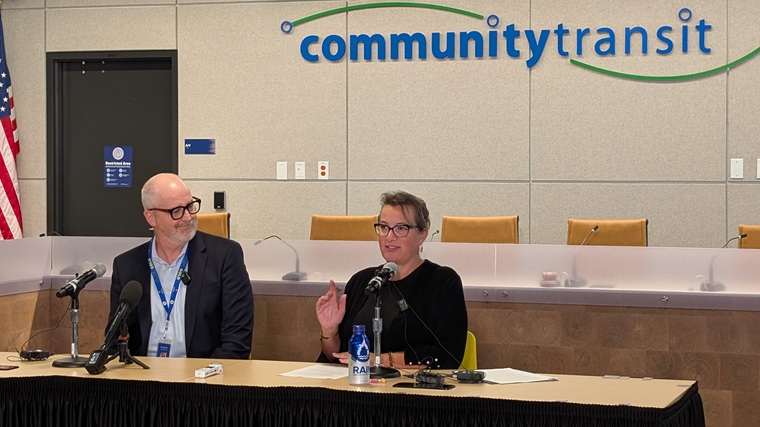
EVERETT – The two public figures spearheading a drive to merge Everett Transit and Community Transit bus service released new specifics about the $54 million merger proposal in an effort to answer questions and increase support for the future of Snohomish County public transit.
Everett Mayor, Cassie Franklin, and Community Transit CEO, Ric Ilgenfritz, presented the document, known as an Inter-Local Agreement, ILA, which would technically annex Everett Transit into the larger Community Transit. The ILA provides more guidance and specifics intended to answer what a consolidated transit agency would look like serving the entirety of Snohomish County.
“People are at the center of this agreement,” Ilgenfritz announced. “Customers who use transit. Customers who could use it in the future and may not be able to today. And the people who deliver the service as we maintain what’s there today and grow it in the future.”
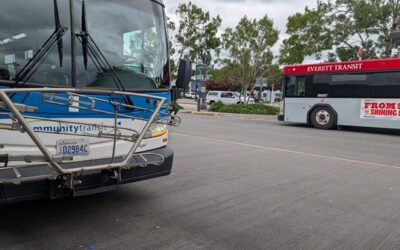
Franklin confronted expected population growth within the city of Everett during today’s press conference to unveil the ILA. “We’re adding 66,000 residents and 40,000 more through (expected) annexation. I do not want to see that many more parking spots, parking garages, lanes on our roads. We really need to to get people of the other options.” Under the state’s Growth Management Act, Everett’s 2044 Comprehensive Plan must legally plan to accommodate 65,000 new residents, 36,500 new housing units, and 84,300 new jobs in the next two decades. An annexation of 8300 acres in unincorporated south Everett is projected to add upwards of 48,000 if the Everett City Council pursues a proposal made earlier this year.
Ilgenfritz echoed the need for transit service growth for his support of the proposed transit combination saying, “The things that excite me about this are the trips that can’t be taken today or are very difficult for any regular person who needs (to) today. Think about the largest employers in the city. Boeing obviously. We’ve got lots of service going in there. We’ve got BRT (bus rapid transit) routes serving that, we’ve got ST (Sound Transit) Express routes serving that, we’ve got various local routes serving that location. The other major employers in Everett don’t have those benefits. Think about the Navy (Naval Station Everett), think about Providence (Hospital). Think about the Port (of Everett) and the waterfront. Those are the next three largest employment centers. If you live in Arlington, if you live in Lake Stevens or Snohomish and you want to be in any of those places or work in any of those places, it’s nearly impossible to take transit today,” noting that such a transit trip would require 3 to 4 transfers and time-consuming travel to reach those locations.
“We have an opportunity to break down those efficiencies in the network and create direct connections,” if the Everett Transit and Community Transit annexation is approved, Ilgenfritz posited.
The newly unveiled ILA would need to be approved by the Everett City Council and the Community Transit Board, respectively, for the next step in the proposed process. Here is a timeline for what’s expected next in the process.
- Sept. 30: Everett City Council meeting – Action on Initiation ILA setting public hearing date
- Oct. 1: Community Transit Board of Directors meeting – Action on Initiation ILA setting public hearing date
- Oct. 28 (anticipated): Everett City Council Meeting – Public hearing on the annexation
- Oct. 29 (anticipated): Community Transit Board of Directors Meeting – Public hearing on the annexation
- Nov. 4 (anticipated): Everett City Council Meeting – Action on annexation
- Nov. 5 (anticipated): Community Transit Board of Directors Meeting – Action on annexation
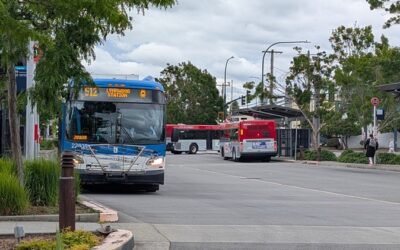
Considering the population growth and how that fits into bus transit service, Ilgenfritz stated, “Everett Transit has a long-range plan…adopted earlier this year. Best case scenario with that plan and the resources available there,” Everett Transit, “could grow services by 25% in the city over the next 20 years. At the heart of this agreement is a commitment to grow service in the City by 50% in four years. So, at that scale, there’s really no comparison,” with the status quo.
Citing rider capacity, Franklin divulged, Community Transit currently drops off riders at the Lynnwood light rail station every 45 seconds during rush hour, “There is not a scenario where Everett Transit can deliver that level of service and that level of service is necessary for these light rail systems.”
Franklin says Sound Transit’s light rail arrival in Lynnwood “really ended up selling me on this merger” of ET and CT. “We saw that transformation that happened in Lynnwood,” with light rail, Franklin said. “There’s a complicated ballet of buses coming and going to the Lynnwood light rail station because people are coming from all over the county to get to that end station. Everett will have the end station alignment,” for light rail when the approved Everett extension and six stations is completed in 2041 under current construction estimates.
Franklin connected the Everett light rail extension to future transit funding saying, “We need to demonstrate that we can deliver riders to those stations. When Sound Transit is competing for federal funding to build those (six passenger) stations, ridership matters. And doing this work now will help us be competitive for those really important federal funding grants to deliver all light rail stations to Everett on time.”
Franklin acknowledged the price tag associated in the proposed annexation process of Everett Transit. ” It’s difficult to think about increasing sales tax. We all care about affordability. And certainly, for me, our (City) council and our community, if we are increasing the sales tax in Everett that those dollars are being put to good use. Everett collects 0.6% sales tax for (Everett ) Transit services we provide. We could go up to 0.9% but we collect half of what Community Transit collects, 1.2%. That really can deliver far greater services than we ever had the capacity to deliver because of that taxing authority.“
Ilgenfritz appealed to current Everett Transit employees, most of them represented by Amalgamated Transit Union Local 883 , who have openly questioned or opposed the annexation plan at council meetings, board meetings and public forums. “Bringing the Everett Transit employees into Community Transit represents an amazing learning opportunity for us. Those drivers, those customer care employees, those inspectors out on the road, they know the community. They know their customers. And for us,” Ilgenfritz said about CT, “we have to learn that and who better to learn that from then those (ET) employees. So, we’re super excited for them to come on board and to see what we can learn from them about serving other parts of the county.”
To publicly comment on the proposed transit agency annexation, in support or opposition, you can type your comments at this website collecting public input.
E-mail your comments to, [email protected]
Snail mail your comments by postal letter:
City of Everett Communications
2930 Wetmore Ave, Suite 10-A
Everett, WA 98201
Call with your comments: (425) 257-7121
More information about the effort to consider consolidation of Everett Transit and Community Transit service, including the ILA, is available at everettwa.gov/transitconsolidation.
The following is an executive summary of the newly proposed ILA that was released today for Community Transit to take over operations and assets of Everett Transit.
INTERLOCAL AGREEMENT FOR ANNEXATION BETWEEN CITY OF EVERETT AND COMMUNITY TRANSIT
EXECUTIVE SUMMARY
The Interlocal Agreement for Annexation sets the terms for the City of Everett to join
Community Transit and for Community Transit to take over operation of Everett Transit
and significantly improve public transportation for the city. Both parties have negotiated
and agreed to terms to support this annexation, which are provided in detail in the
Interlocal Agreement. The proposed transition would take effect April 1, 2027. On that
date, Everett would stop operating its own transit system, and Community Transit would
become responsible for providing transit service within the city.
Employees. Everett Transit employees identified for transfer would become Community
Transit employees on April 1, 2027. Community Transit would assume the applicable labor
agreements and employee obligations. The agreement provides that transferred
employees will not be placed in a worse position with respect to wages, benefits,
retirement, or working conditions.
Paratransit protections. Existing qualified Everett paratransit customers would continue
receiving service equal to what Everett Transit provides immediately before the
transition. The agreement also includes protections intended to maintain continuity in
paratransit staffing, scheduling and dispatch during the transition.
Service for Everett riders. Community Transit would be required to maintain or exceed
the level of Everett Transit service in place when the transition occurs, including routes,
frequency, hours of operation and service span. The agreement is intended to maintain
continuity for riders while allowing Community Transit to integrate Everett into its
regional system over time. The Swift Blue Line would continue operating, and Community
Transit would be responsible for financing, planning, constructing and operating the
planned Swift Gold Line.
Financial agreement. Community Transit would pay Everett $54.5 million as part of the
agreement. Of that amount, $42.5 million reflects transit property and assets—including
Everett Station, buses, charging equipment and other transit facilities and equipment—
and $12 million recognizes impacts and transition costs to City services. Everett would
separately transfer $16 million in existing transit capital reserves to Community Transit
to fund equipment and vehicle replacement. Transit agencies build up such reserves as a
matter of best practice, and this transfer ensures current Everett Transit vehicles can be
replaced when they reach the end of useful life.
Transit taxes. Beginning April 1, 2027, Everett would stop collecting its existing transit
sales tax and the Community Transit sales tax would apply within Everett at the same rate
that applies elsewhere in Community Transit’s service area.
Fares. Everett Transit fares would remain in place for existing Everett service and
paratransit. Community Transit could not change those fares for at least 12 months after
annexation, and any later change would require staff analysis, public engagement and
Community Transit Board approval.
Transit property and assets. Everett would transfer the assets used to operate Everett
Transit to Community Transit, including buses, equipment, certain real property, transit
related contracts and Everett Station. The $54.5 million payment assigns $17 million of
value to Everett Station and $25.5 million to vehicles, charging equipment, parking, transit
facilities and other equipment. Community Transit would also take responsibility for
federal requirements associated with property and vehicles originally purchased or
improved with federal transit funding.
Everett Station and the operations facility. Existing Everett Station tenants would remain
under their current leases, and Community Transit would continue allowing City and
community uses of Everett Station for three years following the transition. Everett would
retain ownership of the existing Transit Operations and Maintenance Center and lease it
to Community Transit. The draft lease provides for $300,000 per year for five years.
Governance. Because adding Everett would increase Community Transit’s service-area
population by more than 15%, the Community Transit Board would be reconstituted
under state law. A meeting of all the cities in Community Transit’s service area, including
Everett, to determine the new board composition would occur within 90 days after
annexation, and the agreement states that current population figures would guarantee
Everett at least one seat on the Community Transit Board.
Investment in Everett. Everett’s transferred transit assets would become part of
Community Transit’s capital improvement and fleet replacement programs. Community
Transit would also incorporate Everett bus stops and shelters into its bus-stop
improvement program, including consideration of transit centers, lighting, signage and
wayfinding, and would extend its speed and reliability program into Everett. Community
Transit would report annually to Everett regarding these commitments.
Transition period. The two agencies would work together during an interim operations
period lasting up to 18 months after annexation, unless the transition is completed
sooner or both parties agree to extend it. Everett would provide certain administrative
and operational support during this period to help ensure a smooth transfer of services.
In short: the agreement would consolidate Everett Transit into Community Transit on
April 1, 2027, while protecting existing service and employees during the transition.
Everett would receive $54.5 million, transfer $16 million in transit reserves and most
transit assets, retain and lease the operations facility, and gain representation on the
Community Transit Board. Community Transit would assume responsibility for operating
and investing in Everett’s transit system as part of the larger regional network.