
EVERETT–Five days into the launch of Boeing’s 737 North Line and the bugs are being worked out of the assembly process as Snohomish County elected officials and company brass trumpet the economic injection underway.
Joe Hollingsworth, a 14-year Boeing veteran and tool construction team lead says the first five days of new 737 assembly in Everett, which started on Monday, did reveal some expected adjustments. He tells EverettPost.com, “Yes, we found things that weren’t ordered or IP’s (internal processes) that need to be modified, (or) corrected. So that’s what LRIPs about is cleaning up the system to make it hassle free.”
LRIP’s the company acronym for Low Rate Initial Process that will set completed initial monthly production targets for Everett-built 737s on the North Line.
“This is where we find all the bugs and clean up all the bugs,” Hollingsworth continues, “so that when we hit full production rate, we’re all clean. The (assembly) system will go naturally. But that’s the whole reason behind LRIP is to find out what was missing for missing parts or process.”
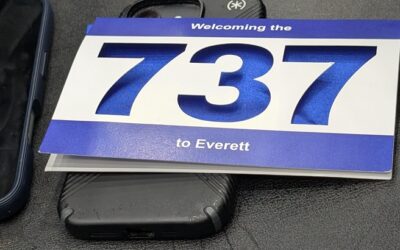
This week’s North Line launch that started Monday concludes nearly four-years of line preparation that Hollingsworth has worked on, saying, “A lot of workers are starting to come in, and they’re realizing, you know, take it slow. Follow processes. Check your IPs. Make sure everything’s passing quality. So it’s, it’s definitely Everett-specific. Follow the guidelines, rules.”
Hollingsworth and a few hundred of his assembly line colleagues joined President and CEO of Boeing Commercial Airplanes, Stephanie Pope, and several notable elected officials for a ribbon cutting ceremony to christen the North Line this afternoon.
Pope praised the assembly teams, saying “your energy, your excitement, the countless hours. We celebrate, not only the start, but all the work that’s been done the last year to get us here. And it’s because of your efforts that guide us here today to launch the 737 production line in Everett so that we can meet the growing demand of our customers.
“This year marked six decades since crews began clearing this site right here that we now call home. Back then, we needed to expand our footprint to house a new ‘larger than life’ jetliner the 747. And then, over the decades, we continue to expand and deliver over thousands and thousands of larger twin aisle airplanes. Now with this new production line, we’ll be building 737 MAXES right here in Everett.
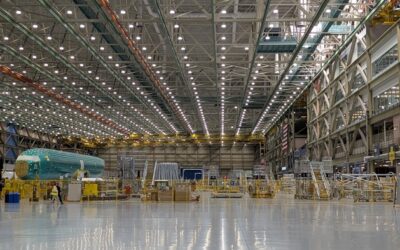
“We have three priorities in BCA and one of them is to deliver safe and quality airplanes to our customers on time. This here is a $1 billion investment to do just that. It builds capacity and resiliency into our factory and our production system. It invests in our incredible teammates through training and experiences so that we can continue to predictively meet our customers commitment. We look forward to celebrating the first airplane that rolls out of here later this year, supporting jobs and economic growth right here at home.”
U.S. Rep. Rick Larsen (WA-2), jovially referred to the new Everett 737 line as the ‘fourth line’ to accompany three previously existing 737 lines in Renton. He said to the crowd, “I like to call it the fourth line because we’re not north of anything in Everett, we’re the center of the aviation world here in Everett,” which drew agreement in applause.
Larsen continued, “Today’s a great day for aviation and aerospace here in Northwest Washington. In the Northwest, aviation and aerospace is really ingrained in our DNA. Boeing has made world-class aircraft for Everett since 1943, when the first facilities opened through sections for the Boeing B-17 Flying Fortress.”
Everett Mayor Cassie Franklin, noted in her speech, “This investment is a vote of confidence in our workforce in a marriage of manufacturing and the future of aerospace in the City of Everett. For generations, our city has been the center of aerospace innovation. From the first 747, 767, the 777 and the revolutionary 787 Dreamliner, this factory has repeatedly shown the world what is possible. In Everett, we don’t just build airplanes in these sole complex problems. Advanced manufacturing can help connect the world. That legacy is exactly why Everett is the right place to launch this next chapter.
“Most importantly, as you can call as you’ve already heard. We have the best aerospace workers in the entire world right here in Everett. (applause line) There is no better team anywhere to take on what’s ahead. Today is a celebration, but it’s also an important beginning. A new production line doesn’t become successful overnight. There’s an important work ahead, training, collaboration, and continuous improvement. But Everett has demonstrated time and again that this community knows how to rise to that occasion. Just as this factory built the legacy of 787, I’m confident that this team will build a great next chapter of the 737 MAX.”
U.S. Rep. Suzan Del Bene (WA-1) spoke about the economic impact in her speech, “And there’s a reason that Boeing chose Everett again for this fourth MAX production line. It’s because Everett, our region, our state of Washington’s, home to the finest aerospace workers in the world. The mastery, the precision, the dedication found on this factory floor cannot be replicated anywhere else. And the impact of the North Line isn’t contained just in these four walls. This opening represents a massive economic boom and an opportunity for our entire region.
“A 25% increase in production capacity will strengthen our state’s position as the global capital of aviation and the ripple effects should be felt across our entire community, supporting more than 1100 local suppliers and small businesses that keep our regional economy thriving.
“This line isn’t just about building airplanes, it’s building a prosperous future for families in Washington. And as we celebrate this expansion and look toward the future, we must also acknowledge the profound responsibility that comes with it. As you begin this initial production phase to conduct the quality checks, the primary focus continues to remain clear: safety above all else.
“Safety and quality are not just metrics. They are absolute Foundation of everything that Boeing workers do at every step of the assembly process. And that Foundation is what protects the crews who fly these planes. The passengers who step on board and the legacy of excellence that defines aerospace here in Washington.”
Boeing outlined the final assembly process for 737s on the North Line with the following explanation.
Flow Day 1: Fuselages are rolled and lifted into flow day 1, where the fuselage is carefully inspected. Insulation, electronic, hydraulic, and mechanical models are installed. The dorsal fin is placed on top.
Flow Day 2: Wires (approx. 43 miles), hydraulic system tubes and flight control cables are laid. If selected by the customer, an optional Wi-Fi antenna and its cover are installed on top of the fuselage.
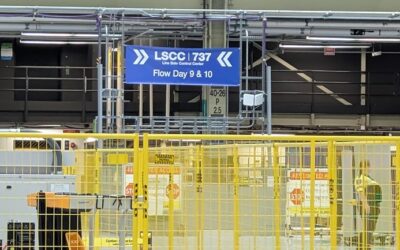
Flow Day 3: Wires and tubes are connected to corresponding electronic and hydraulic modules. Teammates begin installing flight deck panels and testing the hydraulic system. Also, the protective radome is installed on the nose.
Flow Day 4: The airplane starts to take shape with the installation of wings, horizontal and vertical stabilizers and landing gear. Now that the airplane can rest on its own weight, it is rolled to the next flow day.
Flow Day 5: Rear galleys and lavatories are installed, followed by water, waste tanks, and the remaining electronic systems. Cable riggings are connected to flight control systems, and the fuel tanks get a pressure test for leaks.
Flow Day 6: Oil and power are now introduced. Air distribution systems are finalized; mechanical and electronic tests take place. Side walls, overhead
stowage bins, forward galleys and lavatories are installed.
Flow Day 7: The passenger cabin is pumped with air to check for leaks, and the fuel tank is inspected and cleaned out. The landing gear is checked for functionality and flight control systems are tested with simulations.
Flow Day 8: Carpets are cut and seats (138-230) are installed. Testing continues on flight control and hydraulic systems. A “shakedown” (inspection for defects or debris) takes place.
Flow Day 9: Engines are hung from the airplane and connected to the electronic and hydraulic systems. Final Inspections take place before the full customer “presentation” or airplane inspection.
Flow Day 10: The final factory position allows for any remaining installations, testing or
inspections before an airplane leaves the factory.
Wing Build
• The primary difference between 737 production in Renton and Everett is wing
assembly. Wings for the North Line begin production at the Renton site where the
structural elements of the wings will be produced.
The wings are also sealed and
painted in Renton. Before entering Wing Systems Installation, the in-work wings are transported to
Everett on purpose-designed trailers. Once in Everett, the wings complete production in Wing Systems Installation before being installed in Flow Day 4.
Extended-Flow Airplanes
• The North Line will also include four slant positions to accommodate airplanes
that may require additional time beyond the standard production flow. This
includes airplanes that have complex customer interiors, including lay flat seats.