
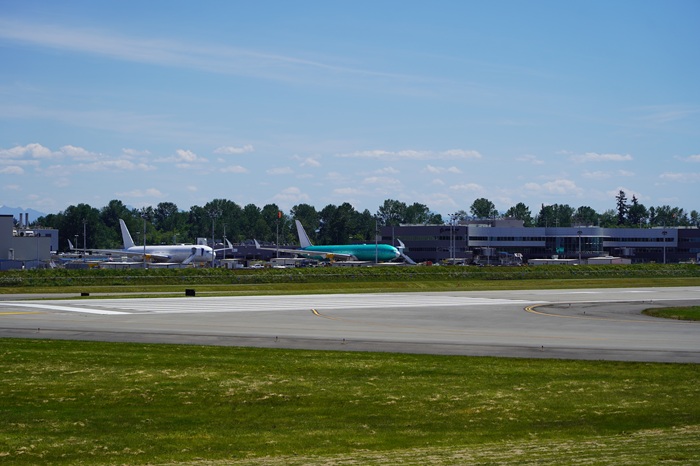
EVERETT – As Boeing opens its new North Line for increased 737 assembly this week, it showcases the fierce competition for producing the “workhorse” narrow body models that airlines want, one aviation financial analyst tells EverttPost.com.
Karl Sinclair, Financial Editor at Leeham News says in aviation, “the meat of the market…is in the narrow body segment. Narrow bodies are the workhorses. They’re the most in-demand aircraft.” He says 80% of all commercial aircraft ordered are narrow body jets. “So, if it’s that much in demand, you’re going to supply the demand.”
Boeing expands 737 production in Everett with the North Line to meet that demand. Sinclair says, “the 737 North Line is key to Boeing’s march to return to a production rate of 52 planes a month, last seen in March 2019 when the MAX was grounded for 21 months.”
The grounding resulted from two fatal 737-8 crashes operated by Lion Air and Ethiopian Airlines. Boeing is still operating under close Federal Aviation Administration oversight following the January 2024 Alaska Airlines door-plug blowout, and several important aircraft models — including the 737 MAX 7, 737 MAX 10 and 777X — remain in certification limbo, delaying deliveries to airlines and keeping completed airplanes in inventory.
Since that production restriction and regulatory scrutiny, Airbus has throttled past Boeing in this market segment.
Airbus currently holds a 5-to-1 order advantage over Boeing on the high-demand and high-production narrow body models of A320 and 737, respectively. “The MAX10 has about 1400-1500 orders for it,” Sinclair tells EverettPost.com. “Airbus has over 7000 orders for the A321 Neo.”
“Now, could that be because Boeing is behind the curve with getting the aircraft certified?,” Sinclair asks rhetorically before answering his own question, “Absolutely. Boeing needs that smooth, steady production where airlines are getting the aircraft. That they (Boeing) can go and say, yep, you can have your delivery slots. We’ve got it open, you’ll get your aircraft.”
Renton factory production, according to Sinclair will be capped at the current rate of 47 planes per month, five aircraft below the 2019 rate.
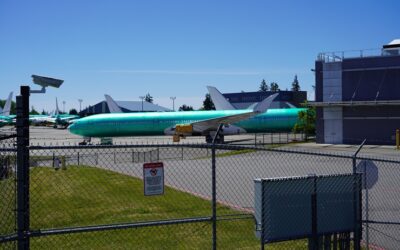
Boeing wants to eventually boost the production rate, he says, to 63 jets per month and even higher, to match Airbus’s plans to assemble 75 A320s a month. The North Line is the key to these goals, Sinclair says, because it’s also a critical piece of returning Boeing Commercial Airplanes (BCA) and with it, The Boeing Co, to profitability.
“In the profitability sense,” Sinclair elaborates, “if you look at 2018 before all this happened, Boeing was coming off a record delivery pace of 800 aircraft (a year). And executives had no expectation this would change moving forward. They were working on ramping up. Let’s get to 850, let’s get 900 (jets built a year). So revenues, expenses, margins, and sales were based on that perception.”
Then the fatal crashes and quality control problems struck the company. “From 2019 through 2025, it could have been reasonably expected that the company would deliver 800 aircraft a year for those 7 years,” Sinclair continues, “so all things being equal, Boeing was projecting everything to handing over 5,600 jets. Instead, Boeing delivered 3,000 aircraft to customers over that for that period. It’s a shortfall of 2600 units.”
A 47% reduction in deliveries that coincided with the COVID-19 pandemic, workplace interruptions, supply chain interruptions and then inflationary sledgehammers.
“Now, those deliveries,” Sinclair reminds, “were sold and contracted by a very different Boeing, who had a different cost structure with cheaper inputs at all levels. Since then, you think of what has changed. Raw materials are more expensive. The suppliers are charging them more. They had to repurchase Spirit AeroSystems. Everything has skyrocketed. Except for the prices of those aircraft.”
“So, the knock-on effect is that there is a patch of aircraft production that Boeing has to work through that is going to be less than optimal in terms of (profit) margin,” Sinclair concludes.
The solution, Sinclair, says for Boeing is painfully simple: be fundamental.
“Boeing needs to get back to boring, run-of-the-mill production where inputs (parts) are going in one door, outputs (assembled planes) are going out the other. Happy customers are walking off with aircraft.”
The Everett North Line holds the key to that future, says Sinclair. “The Everett space is a huge area. And there is potential, there is suitable space for expansion over there. Estimates are that you could easily put in another three to four narrow body production lines in there, in addition to what’s going on right now with the MAX 10. The MAX 10 line was set up there.”
The 737 models start life in Wichita, Kansas where the fuselage sections are hauled by train to Renton and Everett. “Various components come in from all over the world,” Sinclair describes. “Engines from engine makers, interiors from interior makers, avionics from the avionics guys. All these parts come from around the world and are assembled, and it’s really a logistical miracle the way this is put together,” Sinclair notes, foreshadowing his next explanation about the fragility of supply chains.
“And you take a stick and you put it in the spoke of the wheel and everything can really get thrown apart,” he says. “(If) One part is not available, that plane doesn’t fly. The plane doesn’t leave the factory. So smooth production is required for profitability. The industry operates on a ‘just-in-time’ system. You do not hold onto inventory. And time is money.”
Which brings us back to FAA certification to deliver already assembled jets to customers rather than have them parked on tarmacs costing the company coin. “The MAX 7 is going to be the first aircraft to be certified out of the three. It is supposed to happen in 2026,” Sinclair alludes to the regulatory chronology, “Here we are midpoint 2026, and we’re waiting on that. The MAX 10 is going to follow second (later in 2026). And then the 777X—the dash-9 variant–is supposed to be certified in 2027.”
When asked if the 2027 certification will happen in early 2027 or be a months-long wait, Sinclair sardonically replies, “You’re guess is as good as mine.”
For now, Sinclair says, “In my estimation, there is a patch of low margin aircrafts, of inventory aircraft that Boeing has to go through (to deliver before getting to more popular and profitable plane deliveries). And, you know, Kelly Ortberg, the CEO who took over and he’s instituting the culture change that Boeing needs to go through to get it back to an engineering company.”
That means the North Line’s first task is modest: prove the process works. Boeing has said Everett will begin with low-rate initial production, allowing teams to demonstrate conformity before the line contributes meaningfully to higher monthly rates.
“So, Boeing is committed to getting on this path. Doing what has to be done and then just working on getting to smooth production,” Sinclair says projecting the future production numbers. “The Northline can get to five (planes) a month in 2027 and will top out around the 15, 16 per month mark. But there are a lot of moving parts to that. It’s so important, the supply chain. Getting all the suppliers on the same page, delivering Boeing the parts that they need when they need it, so that they can get those aircraft built and handed over to customers. You know, it can’t be understated how important the supply chain is.”
In his final analysis, Sinclair tells EverettPost.com, “Boeing just has to worry about doing Boeing things. Boeing just has to put its nose to the grindstone, get back to its engineering ways, and focus on–and I think Ortberg has the company on the right path—Boeing’s been around for 100 years. They know how to make aircraft.
“They’ve got the airplane that gals and guys over there–the experienced people who know what to do–you just have to listen to them. Let the process work itself, and everything will follow. The production increases will follow. The profits will follow. Everything will happen.
“Airbus is going to do Airbus things.
“Boeing is going to do Boeing things.”
Sinclair wrote recently about Boeing returning to profitability with the July 6 opening of the 737 North Line for Leeham News.