
EVERETT – The daily grind of commuting in Snohomish County comes down to the classic real estate axiom of location, location, location.
Snohomish County, for many years, existed as a bedroom community to Seattle but in the last generation has grown into an economic center of its own with the growth of aerospace, aviation, Naval Station Everett, bio-tech, green tech, the Cascade Industrial Center, tribal casinos and health services among others.
As job centers have blossomed in Snohomish County and jurisdictions have adjusted with housing expansion, commute patterns have changed but freeway and highway commuting is still the norm. I-405 from Swamp Creek in Lynnwood to 85th Street in Kirkland has been under construction in one form or another for nearly half of this century.
Mass transit advocates tout the arrival of Sound Transit light rail connecting Lynnwood to Seattle. Everett’s waiting 15 more years before light rail reaches the city, with expected completion in 2041.
With gasoline prices in Washington amongst the most expensive in the nation, why don’t more people get out of their car to commute via mass transit? EverettPost.com put that question to a variety of elected and civic leaders for their answer to the future of commuting as Snohomish County grows.
“The number one factor for whether people choose to use any form of transportation is whether it’s the fastest and most convenient way to get from point A to point B,” Brock Howell, executive director of Snotrac, Snohomish County Transportation Coalition, begins, “so part of that is how we built out our cities that spread out and its hard to serve those areas in a way that makes transit effective, efficient for moving people to where they need to go.”
Speed and convenience were echoed by U.S. Rep. Rick Larsen, who tells EverettPost.com, “What makes transit commuting helpful is when it’s convenient. It goes where people want to go. It picks up people where they want to be picked up.” The second criteria Larsen suggested, “is something we call headways. How often does it (bus or train) show up at the station?”
He pointed to light rail access in Lynnwood and the flexibility that provided for Community Transit to re-allocate bus service. “And, so, what we’ve seen with light rail here, is CT has been able to change their service area and their service provision to feed both light rail and to expand (bus) service where it wasn’t, because now they’ve got the capacity to do that.”
The proximity of one’s residence to transit was a key factor for Everett City Councilman, Ben Zarlingo, who uttered the phrase “walk shed”, explaining, “transit people use the term walk shed as opposed to watershed, and that’s how far we expect people to walk from their houses to a transit stop,” before quickly acknowledging that the advance of battery powered devices is shrinking that distance to access transit.
“It turns out that electric bike or electric assisted bike or an electric scooter or something can get you (there) faster and more convenient, and maybe with less exertion or sweat that you have to counter with a shower when you get to work or whatever, then more people will find this practical,” Zarlingo asserted, seizing on that personal hygiene dilemma that usually dissuades someone from ditching the car and biking to work. “And, so, if it was a 15 minute walk, and it now is a five-minute scoot, then that might work,” he postulated regarding mass transit usage.
Switching to mass transit comes down to force of habit, Steve Oss, President of Amalgamated Transit Union 883, tells EverettPost.com. “Habits are the things that really drives riding the bus,” before adding, “you have to make it attractive. You have to make it safe. It has to be efficient.” ATU local 883 represents employees of Everett Transit, the transit agency serving the city of Everett.
“You have to meet all those goals to get the people to ride the bus. If you’re not efficient, you don’t have the confidence that if you go out to the bus stop, the bus is going to be coming. You have to earn their (passengers) confidence,” Oss, a former bus driver himself, says.
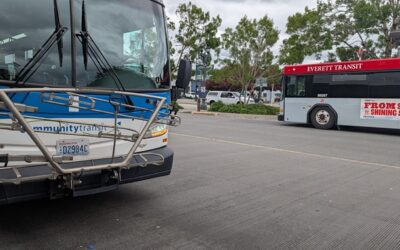
Oss acknowledged the 21st century changes in housing and job growth patterns seen in Snohomish County, saying, “Sometimes you have to have changes to bus schedules because a new business (opens or grows), because demographics have changed. Whenever that happens, just because you put it (bus stop) where it logically makes sense, that does not mean you’re gonna get all of your passengers when you start providing the service. People have to find out about it, and it probably takes about 5 years to establish that new (bus) route.”
Oss compared approaches he’s noticed between ET and CT for attracting new riders, “We have had routes that have been consistent for decades. Every now and then we’ll try a different route. We’ll change it up a little bit, and it frequently takes time to build it into a pattern or a habit where people go ‘Oh, I know that bus is going to be there’, and they go out and get it.”
Of those changes, Oss emphasized, “If you’re gonna do it, you gotta do it, and you have to advertise it sometimes. Everett Transit, you don’t see Everett Transit advertised all over the place. You do see it with CT. CT is very active in their advertising.”
Expanding service times and locations were the ridership answers Megan Dunn, Snohomish County Council member, cited. “If we’re able to have more stops, more connections, longer service times, more people would be able to have those barriers removed and have access to transit,” says Dunn, who is also a CT board member.
Kirk Hovenkotter, a Seattle-based mass transit advocate for the Transportation Choices Coalition, advanced that premise of Dunn’s saying, “I think people do get out of their cars when they’re given options. I think we are starting to see that in the places in the region where we built light rail. When we give people fast frequent and reliable transit, they take it. And I think we just are catching up from decades of under investment in walking, biking and transit and we’re finally just providing options that are compelling to people.”
Those nuts-and-bolts of mass transit service underpin ridership success says SNO-TRAC’s Howell, “The number one thing, though, is being able to make sure that we have sufficient frequency and directness of our transit lines, such that it makes it a reasonable alternative for someone to choose to take transit rather than to drive, and that’s the biggest challenge that we have today in Everett.”
Evaluating this commuting question in the context of how Snohomish County has changed over the last quarter-century, Howell examines the 20-year projected population growth Everett is expecting, “In Everett, for example, the population growth is targeted it to be another 65,000 people…up to 2044. That’s a big increase in the population of the city, a real challenge to make sure that we can accommodate those people in terms of housing and jobs.”
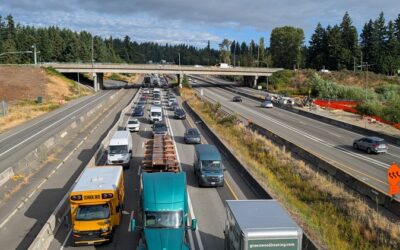
Howell sees the population growth as an opportunity that aligns with the 2041 expected arrival of light rail in Everett. “The city of Everett, like most of the cities in Snohomish County, have put a real emphasis on up-zoning the areas around the future high-capacity transit. Even communities like Marysville and Arlington have thought about this as well,” pivoting from the mobility to the residency, “the more housing that we can put near those high-capacity transit lines means that as we make the investments and build out that infrastructure, that we will have a better transportation system than we would otherwise.”
Larsen concedes, “I think there’s always going to be people who are going to drive.”
Howell admits the future commute will still be a grind, “We’ll still have challenges, right? We’re not going to all of a sudden have an open I-5 freeway where everybody has an open lane to get around. But if all those new 65,000 people were driving, I-5 would be much worse, and our economy would suffer as a result of it. So, it’s really key that we make sure that the new folks and the new houses and jobs have access to that transit line.”
EverettPost.com would like to hear your commuting story. If you commute by car, tell us why. What are the pros and cons that impact your decision. Also, if you’ve switched to mass transit from driving, we’d like to hear that, too. Tell us so the Snohomish County leaders can hear your voice. We’ll share those e-mails on a future story here on the website. E-mail your commuting story to us, [email protected] .