
EVERETT — The evolution of technology and housing construction are converging in Everett, harnessing the power of artificial intelligence to address the sore spot of expediting more housing supply for the goal of making housing more affordable.
Everett mayor, Cassie Franklin, and former Washington governor, Christine Gregoire, jointly announced an effort by the city, today, funded in part by Gregoire’s group, Challenge Seattle, to apply AI to the screening process for building permits.
Franklin says the permit review process with AI aims to reduce the approval time from 250 days to 90 days for an accessory dwelling unit (ADU) project. The Seattle company, Govstream.ai, is providing the AI technology to combine with the city’s existing permit web portal.
High tech meets home building to reduce the time-consuming process of paperwork with building permits and speed construction approval in Everett.
To start off, the AI permit screening program will only be used for ADU and detached ADU (DADU) construction projects. ADU and DADU are becoming more common as the state and the city attempt to zone single-family, residential lots so that owners can build backyard cottages to serve as new dwellings. The Everett AI pilot project will open to “selected beta testers” in November, Franklin says, as the city proceeds “to refine it and aim to make it available for the public. In early spring, we expect to expand the tool to single-family residents and other residential housing types shortly thereafter,” to bolster housing supply and moderate housing prices.
City staff say the pilot project analyzed 281 ADU and DADU applications submitted between January 2023 – June 2026. It found that 95% received at least one correction letter from the city to the applicant requesting un-submitted information to complete the permit paperwork. The median application, the city reports, took 252 days—8 months—to reach permit issuance and went through four review rounds, each lasting a median of 45 days.
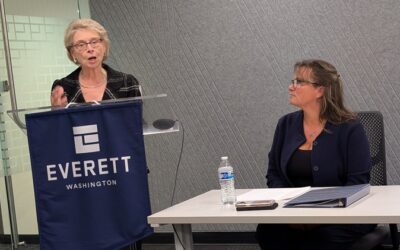
“We looked at our performance,” Franklin says of that 281 permit applications, “and it really wasn’t pretty. That’s simply not acceptable.”
Gregoire stated, “We need more homes. We need to build faster, but lengthy, unpredictable permitting is making it harder.” The permit process, Gregoire, lamented, “can put a project financially out of reach entirely. (It) won’t pencil because of the delay, delay. That time is money to a developer and a builder. That’s why what Everett is doing is so important.”
Everett and the Seattle tech company, Govstream.ai, are coining the phrase “intelligent intake” to describe AI’s role in this pilot project. CEO and founder, Safouen Rabah, tells the EverettPost.com, “our North Star is to shrink the permit cycle.”
“We set out to address the first big bottleneck in permitting everywhere,” Rabah remarks, “which is the intake process. Too often, too many folks submit the permit application, and that permit application is incomplete one way or another for one reason or another.”
That, Rabah, says is why AI can produce dividends at the beginning of the permit application process. “In the cities in our state, about 70% of permit applications are incomplete the first time. And it’s not just annoying when they’re incomplete. People have to resubmit. (City) staff have to look at it, determine why it’s incomplete. That takes time and effort. Then they have to tell the applicant what to do (next). That takes time and effort, and that just introduces delays.”
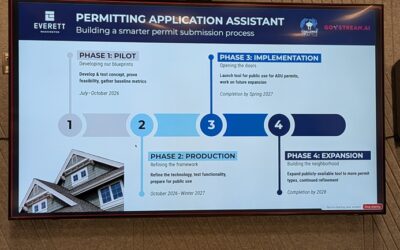
Eliminating the delays is where AI should be able to instantly address missing documents or information in the application process that can be done faster than human eyes and it frees up permit review staff to handle other parts of the process.
Regarding the AI component in the application process, Franklin underscored, “None of this replaces people. It helps the expert permitting team that we have focus really on getting those projects through once they’ve submitted all their materials. But there’s always human eyes on it (the application). Always. Always. Every level. It just helps us move through this step one, which shaves off a lot of time.”
The prevalence of lengthy permit delays is why Gregoire, CEO of Challenge Seattle, is staking a $130,000 grant to the city to expedite building permits faster. “This is a problem that’s prevalent throughout all of Puget Sound and frankly across the state,” describing the permit process like a game of ping pong between property owner or developer and city permit staff, “back and forth and back and forth. That’s not a good use of the talent that’s in charge of giving out the permits. It’s not a good use of the people who are trying to build.”
Everett is funneling $70,000 of city money into the AI permit review as a matching fund to Challenge Seattle’s contribution.
As the pilot phase advances for the AI permit review in 2027 and the application process is expanded from ADUs to larger projects like apartments and multi-family construction, Gregoire sees the AI review being implemented for commercial and industrial construction projects, too.
“Time is money for a family that’s investing in savings and a backyard cottage. An unnecessarily delayed permitting process can cost them exceeding amounts of money and months of uncertainty. Challenge Seattle is providing additional funding to expand this work across all permit types, including those needed to open and expand a small business.
“We want to make it easier to build a home easier to open a business and easier to invest in Everett. This is a win for the city and its staff who spend less time chasing paperwork and more time doing what they were intending to be hired to do in the first place.
“It’s a win for our residents here in Everett, who need more homes in a more timely way at prices they can afford. It’s a win for business who need clear, predictable path to open their doors to expand and to create the jobs we all want. And it’s a win for the region as Everett will be the model for Puget Sound, and for that matter, the entire state on how to go after this challenge and be successful.”