
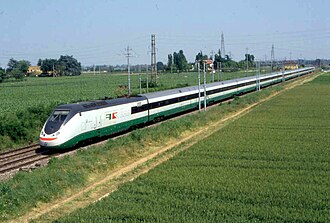
EVERETT – A 200 m.p.h. high speed train zooming passengers from Vancouver, B.C. through metropolitan Puget Sound to Portland, Ore. has tantalized travelers and politicians alike for at least a decade in the Pacific Northwest.
For 10 years, the effort to study and estimate such a high-speed rail corridor has grown gradually with the Washington State Department of Transportation at the epicenter of the international, two-state program currently in place.
The Cascadia High-Speed Rail vision began with funding from the Washington Legislature in 2016, administered by the WSDOT and supported by the Federal Transportation Administration, British Columbia provincial government and Oregon Department of Transportation. The program is official titled “The Cascadia High-Speed Rail and I-5 Program”, which aims to address the future transportation needs of the Cascadia megaregion, according to WSDOT, “to look holistically at highway, rail, air travel, and other travel options.”
WSDOT recently held a HSR briefing and Everett City Councilman, Ben Zarlingo, attended the session that was delivered to local and regional officials.
“What they’re trying to do is integrate the planning that they do for I-5 with a potential Cascadia High-Speed Rail,” Zarlingo described, “and that makes perfect sense that these things interact with each other and to some degree in terms of Portland to Vancouver BC, they are trying to solve the same problems, moving people and freight between the places.”
HSR systems in Europe or Asia have fueled the notion that 200-m.p.h. train travel would be viable in the United States. California Gov. Jerry Brown first proposed a HSR line in the Golden State in the late 1970s.
Zarlingo tells the EverettPost.com, “It is easy to look at the systems that seem to be kind of doing well and providing a lot of value and want that same value for our region. The thornier thing at least one of the thornier things is that doing that here will be different. We have different terrain. We have different road networks. We have different needs for freight and population movement, and so it is a complicated question, and it’s a very big one from the standpoint of the kind of investment that we will be doing in roadways and potentially this (high speed) rail and other rail over the years to come.”
Expected growth in population, vehicle traffic and freight all play into the future needs of the 285 mile I-5 corridor linking the U.S.-Canada border with Portland, via Seattle. That future function is part of the WSDOT-led effort to study the travel possibilities on the corridor and examine how HSR could fit into it.
Zarlingo applies an Everett perspective to what he heard at the briefing. “As the city council person who’s thinking most of the time about local issues, this is so big and so complicated and so expensive that it can tend to feel like a little more of an abstract discussion at this stage.” He asks, rhetorically, “Where are the right of ways? Where is the funding? Where is the will? What is the best design? And would we end up, for example, with maybe a kind of a hybrid system where we use some existing track. We use some of I-5 right away, and some of it new right away is acquired.”
Anticipating that vision for where a HSR line would be located is part of the next phase for the Cascadia HSR I-5 program. Since January 2025, WSDOT and its partners have been working on a Service Development Plan to evaluate the economic and technical viability of high-speed rail in the Cascadia megaregion. This planning effort considers economic and environmental factors, including population and employment growth, travel demand, protected natural areas and geographic conditions.
Upon completion in 2028, the Service Development Plan will:
- Identify potential route options where high-speed rail could operate.
- Examine conceptual service options by considering factors including number of stops and frequency of service (how often the train would run).
- Identify potential governance and finance options.
The Service Development Plan will not:
- Select a preferred route.
- Identify station locations.
Zarlingo acknowledges a few likely scenarios involving HSR. “There are two, three options,” he foresees regarding a HSR pathway, “One of them would be to create an entirely new rail route that might not run directly through Everett. Maybe you’d go farther east, if you want to get on the other side of the Snohomish Valley and maybe have a little more room. You might be closer to Highway 9, for example. Or you might run through Everett, but you might use what you can of the I-5 right away that runs through here. And maybe there’s something elevated that takes advantage of the freeway right of way, which is a good reason for the (WS)DOT to be integrating this planning with I-5.”
The third possibility Zarlingo heard at the WSDOT HSR briefing, “Was discussed by a couple of public commenters in the meeting was the practicality of leveraging the existing rail corridor and expanding that. So, run faster, newer, more capable trains on existing rail, but improve that rail and maybe add additional tracks or loops to better use the rail. But to run those with newer trains at higher speeds.” This hybrid option would utilize some existing right-of-way with current freight and Amtrak rail already in existence and ostensibly supplement it to accommodate extra capacity and track space designed for HSR.
The right-of-way access to facilitate 312 miles of HSR between British Columbia and Portland has some pros and cons within the corridor that are split in the middle of the path. Zarlingo points out, “If you’re trying to go, say Portland to Seattle, versus Seattle to Vancouver, the challenges are different. And hear in Everett, for example, we’ve got kind of a narrowing of possible routings because of the Snohomish Valley and agricultural area, and I-5 and Puget Sound. So, if you’re trying to do something coming through Centralia or Chehalis, well, you probably have a lot of options. If you’re trying to run through Everett or bypass it, somehow, you have a much more difficult time,” to connect the HSR line northward.
The elephant in the room for the Cascadia High Speed Rail and I-5 Program is projecting a cost. The most recent projected cost WSDOT made was issued before COVID, in 2017, with an upper end price tag of $42 billion. Inflation has exploded in the aftermath of COVID, casting that $42 billion price into certain doubt. For comparative purposes, adjusted for inflation from 2017 to 2026, the current price estimate for HSR Vancouver B.C., to Portland will pencil out at $63 billion, roughly $201 million per mile.
In 2008, California voters approved a San Francisco to Los Angeles HSR line that has become mired in cost-over runs and a loss in federal funding. California’s 2008 plan went to voters with a $33 billion estimated cost and a 2020 completion date. The expected price tag for the SF-LA line now tops out at $231 billion for the 383-mile route, which has ballooned with the price of post-COVID inflation and legal obstacles.
Constructing a new freeway or interstate lane generally ranges from $2.5 million to over $10 million per lane-mile in rural or suburban areas and can spike from $20 million to more than $60 million per lane-mile in complex urban environments. By comparison, California HSR costs are estimated to cost between $200 million and over $400 million per mile depending on the specific segment, including overall system optimizations and legacy design assumptions, according to several reports and analysis.
“And then you have to ask yourself, how many billions are you going to spend to save how much time?”, Zarlingo contemplates before elaborating, “I don’t want to minimize this as an important issue, but I also want to provide the context that it’s got a lot of facets to it. It’s got a lot of uncertainties. It’s got enormous expense, and so in a way, I think it’s good to do the planning together with I-5, but I suppose we’re still at kind of an early stage.”
With the estimated HSR price-tag still undetermined, there is another economic factor at play known as opportunity cost: a dollar spent on one item cannot be spent on another item. The City of Everett, Snohomish County, and the State of Washington all have projected budget deficits. The U.S. government is in debt $40 trillion and counting. Could the $150 million currently being spent to study HSR and the I-5 corridor be saved or spent on something more intrinsic to the state?
Zarlingo acknowledges, saying, “You bring up an absolutely legitimate perspective.” Citing the HSR complexity and distant future timeline, he replies, ”The counter to that, and I’ll offer it not out of my own belief or conviction, but because I think it’s a natural argument, is that there is so much, that is so impactful, especially as it will one way or another impact what we do, what we spend on, how we improve I-5 and decisions we make about how much we improve I-5, since that is many billions (of dollars) as well. You could make the argument that even this kind of relatively large chunk of money to do planning and analysis is probably well spent because it leverages so many other future dollars, even if the Cascadia (HSR) project is delayed. So those are the arguments I have to say (because) this is so big and complicated that I don’t come down real clearly on either side of that. I’m at this stage, mostly listening, trying to understand the issues and think about how they will affect the city decision that we actually will be faced with making.”