
EVERETT — Zap Energy, a leader in developing fission and fusion-based, carbon-free power, just secured federal approval for a new type of breakthrough capacitor that reaches an expected 20-year life cycle necessary to sustain fusion reactions for clean power generation.
The U.S. Department of Energy has approved two Zap Energy capacitor development milestones following review by an independent expert panel. The first approval is for the detailed design of a 35-kilovolt, actively cooled capacitor, projected to operate for 6 billion pulses at 10 Hz. Those 6 billion pulses are key to this capacitor testing approval, Zap Energy explains, saying commercial high-voltage pulsed power capacitors are typically rated for about 100,000 pulses. A fusion power plant operating at 10 pulses per second over a 20-year lifetime will need capacitors capable of roughly 6 billion pulses.
Pulsed power capacitors store electrical energy and release it in fraction-of-a-second bursts. In pulsed fusion approaches, these bursts help drive the fuel into extreme conditions where fusion reactions can occur and release energy. Such capacitors are supplied by a small number of vendors worldwide, and commercial units are typically rated for around 100,000 pulses. This pulse rate expansion by Zap Energy involves a 60,000 time increase in operational life to keep power generation operating consistently.
Pulsed power, according to Zap Energy, delivered quickly and reliably by banks of high-voltage capacitors, is a key enabling technology for many approaches to fusion energy, including Zap Energy’s sheared-flow-stabilized Z pinch. Developing capacitors capable of operating at high repetition rates over billions of pulses is an important step toward commercial fusion power plants, the company advises.
The second DOE approval involves a first prototype designed, manufactured and tested entirely at Zap, headquartered in Everett, with capacitance remaining within 0.25% across hundreds of cycles at 8 kV and more than 7,000 amps.
The company says these are the kinds of engineering advances required to move fusion from experimental systems toward practical power plants. The federal approval demonstrate progress in both long-life capacitor design and the U.S.-based manufacturing capabilities needed to produce these components at scale.
“Commercial fusion requires more than achieving fusion conditions. It requires the technologies around the fusion core to operate reliably, repeatedly and at power-plant scale,” said Zabrina Johal, CEO of Zap Energy. “Pulsed power is one of those critical enabling technologies. These milestones demonstrate progress toward the long-life, high-repetition-rate systems a commercial fusion plant will need, while building the manufacturing capability to produce them here in the United States.”
Zap’s 35 kV, actively-cooled capacitor uses self-healing metallized polypropylene film, which degrades gradually rather than failing outright, and places several capacitor sections in series inside each winding so the film sees only a small fraction of the terminal voltage. Integrated active cooling allows continuous operation at 10 pulses per second (10 Hz).
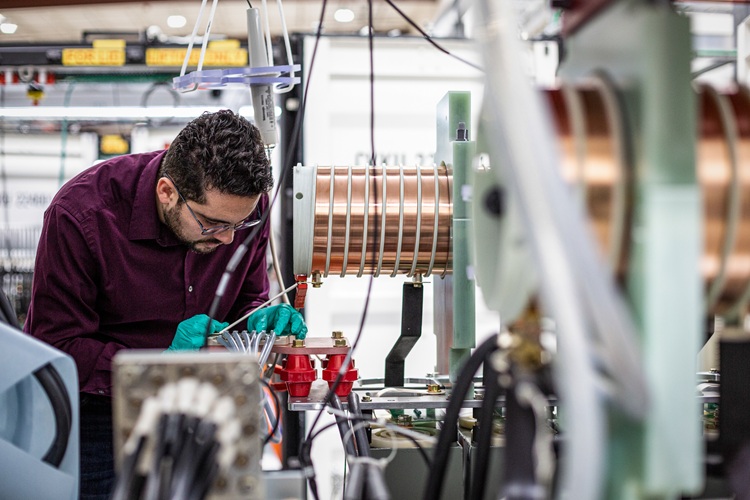
Separately, the new prototype is a compact, 2.8-pound epoxy-potted capacitor built with the same multi-section winding approach. Zap wound, arc sprayed, assembled, potted and tested the unit in house, cycling it hundreds of times at 8 kilovolts and over 7,000 amps along the way. Its capacitance held steady to within 0.25% across the full test campaign, exceeding every prototype milestone criterion.
“One goal of the DOE Milestone Program is to support parts of the fusion supply chain that enable progress across multiple fusion approaches, as well as establish new U.S.-based manufacturing,” explains Zap’s VP of Federal Programs Ryan Umstattd. “Eventually we expect long lifetime, high repetition rate capacitors to be bought off the shelf and needed by the thousands in fusion power plants, but first we need to develop the designs, manufacturing techniques and qualification standards that meet the necessary specifications.”
Zap’s next step is to test the designs to higher voltages, longer lifetimes, and with voltage reversals so that they can be implemented in future Zap fusion power banks. Zap’s website says it brings together experts in plasma physics, nuclear engineering, advanced manufacturing, energy systems, and turning breakthrough science into deployable technologies designed to meet real world demands.
Zap Energy’s mission statement is building integrated nuclear energy platform across advanced fission, fission-fusion hybrid and fusion technologies. Their strategy pairs a near-term path to deployment through modular fission with differentiated hybrid technology and the long-term potential of fusion power. Fission systems provide the first path to market, the company says, while building the manufacturing, operational and regulatory capabilities that support the broader platform. Hybrid systems are designed to use fusion neutrons to amplify fission power and unlock additional energy from spent nuclear fuel. Zap’s compact, sheared-flow-stabilized Z-pinch approach advances fusion without the large magnets or lasers required by other approaches. Shared capabilities in nuclear engineering, advanced materials, liquid metals and power systems allow each stage to accelerate the next, creating a foundation for scalable, reliable, carbon-free power.