EVERETT — There’s a question about Sound Transit’s light rail line expansion from Lynnwood to Everett that Snohomish County Council chair, Megan Dunn, says people keep asking her. The question, Dunn, summarized, goes like this, “The question I get the most is, ‘why don’t we just go up the spine, up I-5 and go straight up (from Lynnwood) because it would be shorter and potentially cheaper?"”
Dunn registered this question during a briefing with Sound Transit’s Everett Link Extension (EVLE) officials during the latest Snohomish County Council meeting. The question bears consideration as Sound Transit re-evaluates promises made to voters in 2016, when ST3 passed for a $54 billion price tag to complete light rail to downtown Everett, downtown Redmond, downtown Tacoma, West Seattle and Seattle’s Ballard neighborhood.
Ten years later, Sound Transit’s promised light rail expansion is an estimated $34 billion over-budget and some of those promises–like a light rail line to Ballard–have been scuttled. The I-5 question Dunn conveys is rooted in the question of reducing light rail costs. According to Sound Transit’s EVLE staff during the exchange in the County Council briefing, it comes down to where light rail can pick up more riders.
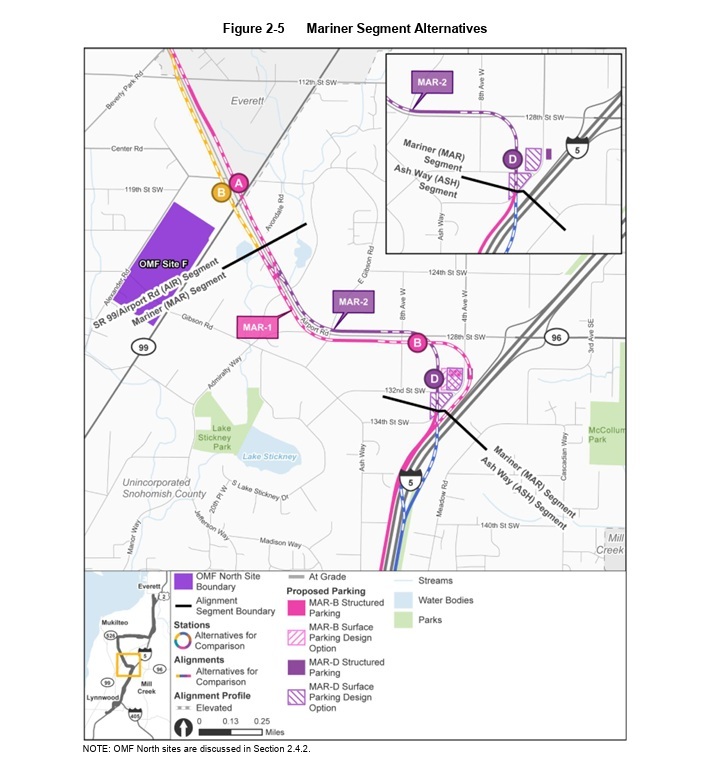
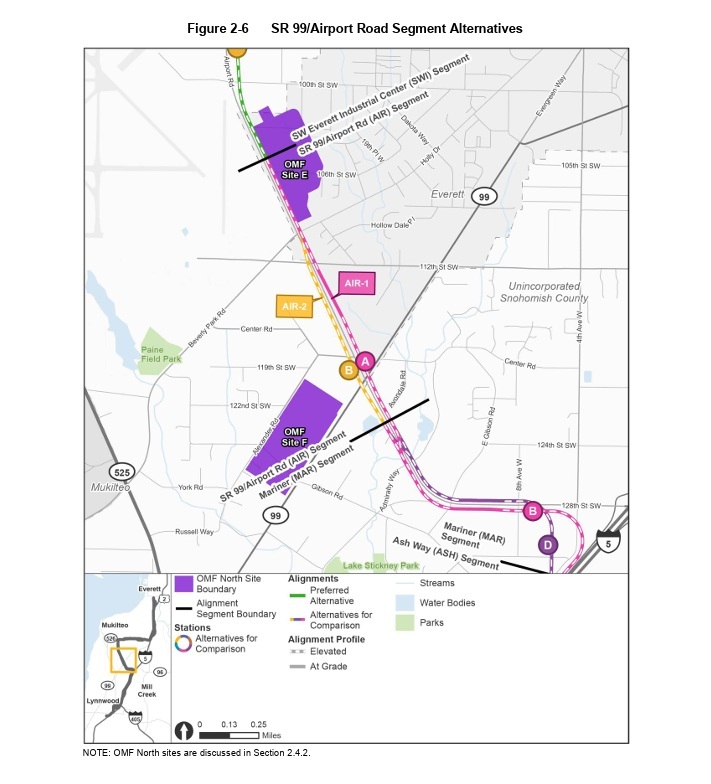
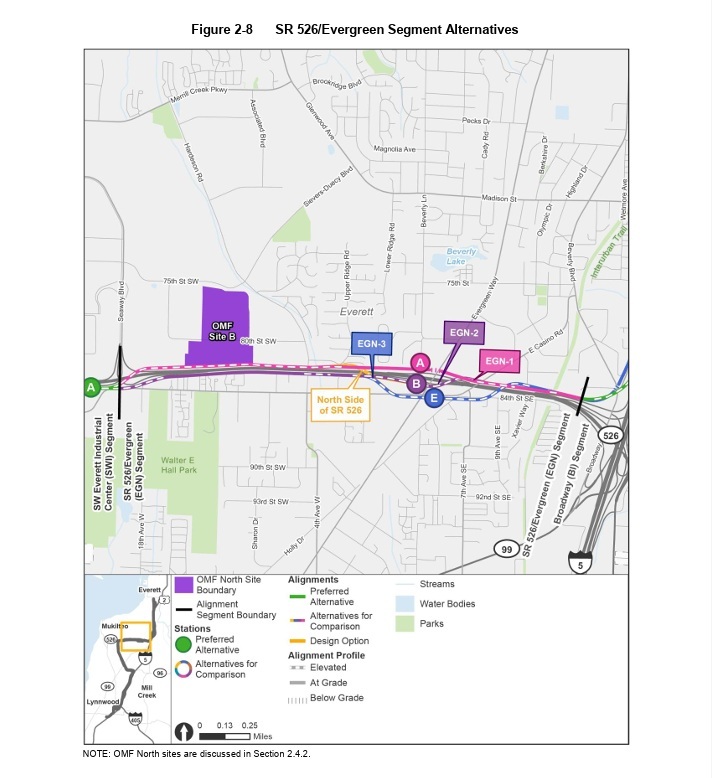
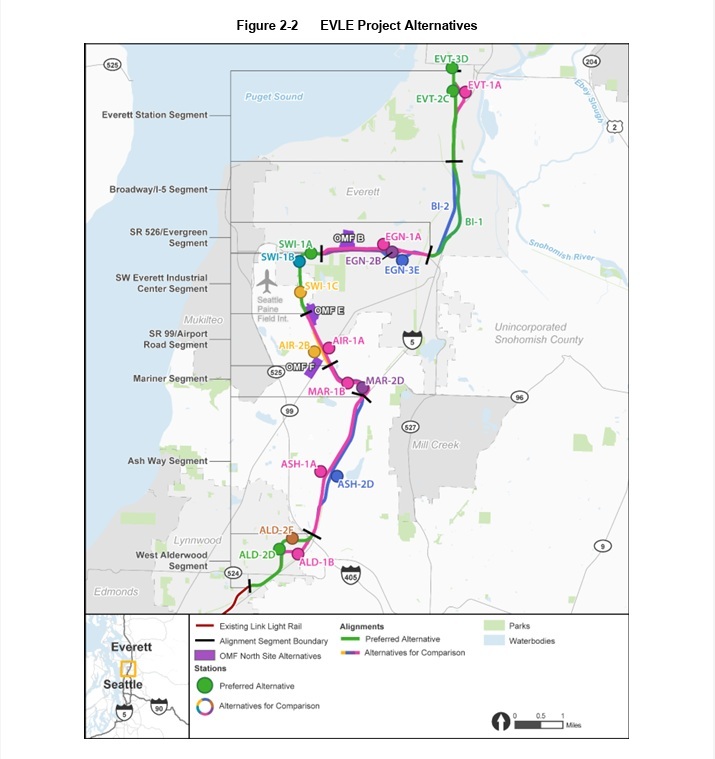
The following transcript is the exchange between Council chair Dunn and Eric Widstrand, Sound Transit HCT (High Capacity Transit) Corridor Development Director. The discussion started with Dunn remarking about the proposed siting of an ‘operations and maintenance facility’, known as OMF, required for light rail car servicing. An OMF is essentially a repair or service yard for light rail cars when not actively in use on the line. The current Lynnwood to Everett light rail extension plan proposes selecting one of three locations for the OMF. The OMF site location is one of the primary questions the public is being asked to answer as part of EVLE’s Draft Environmental Impact Statement, along with where potential passenger stations might be located. The public comment period for making these determinations closes on November 2.
You can click this video of the Snohomis County Council meeting, and scroll ahead to the 56:26 mark to watch the exchange.
Dunn begins, “The OMF site, siting that, it doesn’t look like there’s a really good alternative. All three, it sounds have something not great about all of them. The question I get the most is, ‘why don’t we just go up the spine, up I-5 and go straight up because it would be shorter and potentially cheaper?’ I know that we’re too far into this, I assume, to make that massive change, but are there OMF sites along I-5 that would work? And would that be enough to consider looking at just going straight up, and following I-5? That’s the question I get the most.”
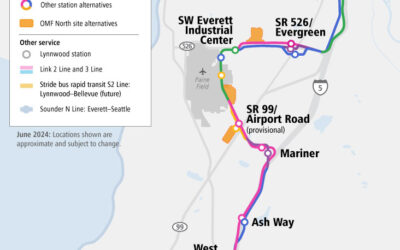
Widstrand responds, “Yeah, I think that I’ll take the first part about going up the (I-5) spine. We have looked at this going straight up I-5 previously, prior to the environmental analysis (Draft EIS). I would also kind of just put a little context behind it. So, the alignment that goes west towards Boeing and Paine Field, and then east along (Hwy) 526, that was the alignment that was selected as part of ST3, and that voters approved back in in 2016.
“While getting to downtown Everet, would certainly be quicker to go up I-5, you would lose a lot of the ridership with that westward swing. You wouldn’t be able to serve historically under-served communities in Casino Road. You wouldn’t able to take advantage of employment centers that Boeing and the airport adjacent manufacturing would bring. And you wouldn’t be able to serve the now increasing commercial aviation taking place at Paine Field. So, while (it) may increase the travel time to Everett by five minutes or so, you really are increasing the ridership and the service area that the corridor provides.
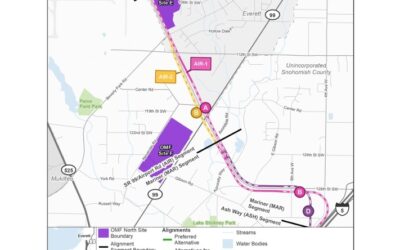
“On the OMF front, we started out probably looking at close to two dozen alternatives back at the project started–20 or so sites. They are difficult to site. There are no good alternatives we have left, and the alternatives that have been screened out have been worse.
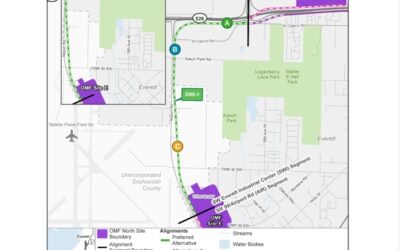
“I don’t think there’s anything size wise, 80 to 100 acres along I-5 that would benefit or be purchasable and available for an OMF site? No one wants to have these cited on what is currently income, generate or income generating properties such as Everett Mall.
“So, we are stuck with trade-offs on these sites. Each of them has challenges OMF-F–the farthest south would have the most impacts to residential properties. OMF-E has a wetland impacts and smaller numbers of commercial and residential property takes (acquisition costs), although it is the lowest cost of the three. And then OMF-B, north of SR-526, has impacts to specialized businesses, highest cost due to grading challenges and additional environmental impacts.
“So, they are challenging to site, and so we’re left with these and really trying to help the (Sound Transit) board weigh the trade-offs for each of these remaining three sites that we’re studying.”
Dunn replies, “I would just note that the voters voted on a timeline as well as a general outline (for the light rail line pathway).”
Despite the frequency of the question, it appears that the ship has sailed on reducing costs in favor of expanding ridership.
Below are larger images you can click to see the proposed OMF sites in the Draft EIS of the $12 billion, 16-mile EVLE.
You can register your public comment on the Draft EIS in any of the following ways before November 2:
Online via Sound Transit’s website
Calling Sound Transit, 425-243-6255
Email: [email protected]
Snail Mail: Everett Link Extension
Attn: Galeeb Kachra
Sound Transit, 401 S Jackson St, Seattle, WA 98104